

Choosing an email verification API is a developer decision dressed up as a marketing one. Every vendor has a REST endpoint and a landing page full of accuracy claims; what actually decides the integration is how the API behaves in production — how it returns a verdict, how it handles the slow part, and how it fails. This guide is the criteria that matter, with the options compared on the facts.
The short answer#
All the major verifiers expose a REST API, so "has an API" is not a
differentiator. What separates them for a developer is narrower: whether the
response is machine-actionable evidence or an opaque score, how they handle the
unavoidably-async SMTP check, whether bulk results arrive by polling or a signed
webhook, the retry and rate-limit story, and where the data is processed. Pick on
those, not on the accuracy number on the homepage. Competitor facts below were last verified July 2026 — confirm on each vendor's API reference before building.
What actually matters in a verification API#
Here are the criteria worth grading, each with what to look for and — as a concrete reference — how Qualisend's API answers it.
1. A machine-actionable verdict, with evidence#
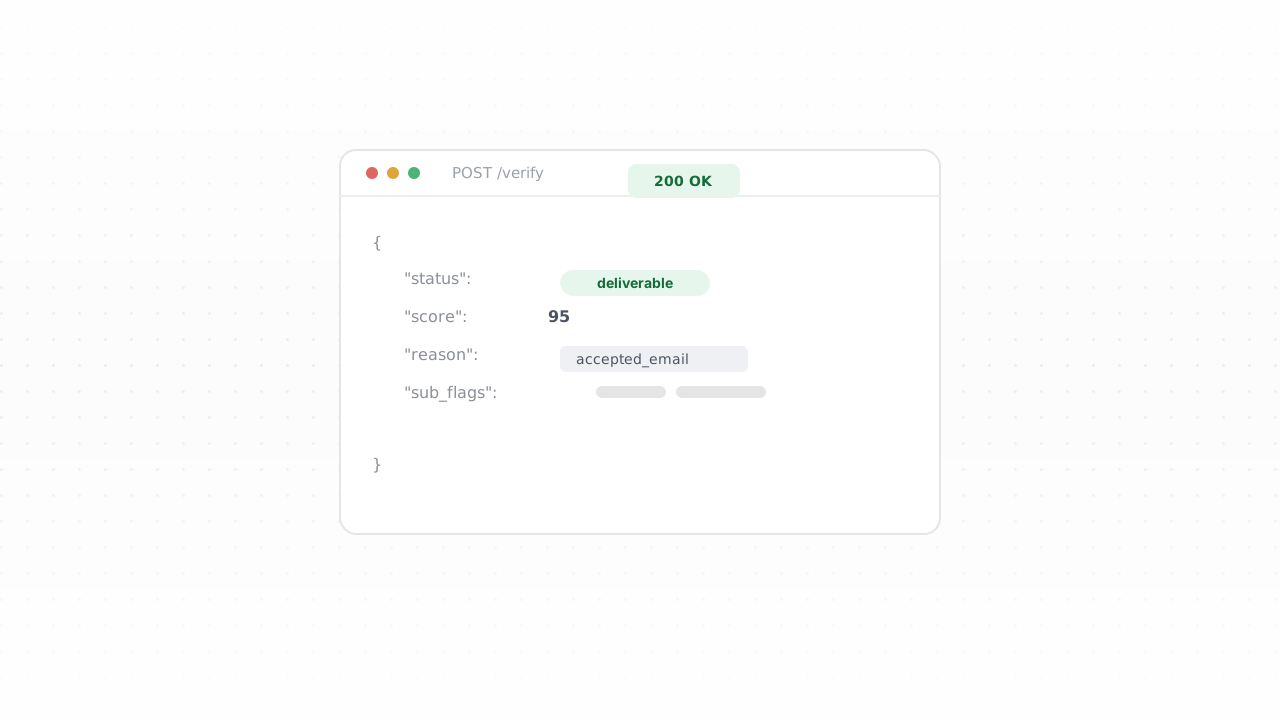
The response is the product. You want a small, stable verdict your code can
branch on, plus the evidence behind it — not a bare 0–100 you have to trust. A
four-way status (deliverable | risky | undeliverable | unknown) with a reason
code and sub-flags lets you write real logic; a single "confidence: 87" forces
you to invent your own thresholds.
{
  "result": {
    "status": "deliverable",
    "score": 95,
    "reason": "accepted_email",
    "sub_flags": { "role": false, "disposable": false, "free": false, "catch_all": false },
    "did_you_mean": null,
    "smtp": "done"
  }
}
2. Sync or async — and honesty about it#
Confirming a mailbox means an SMTP round-trip to a server you don't control, so
the SMTP part cannot be reliably instant. An honest API says so. Qualisend's
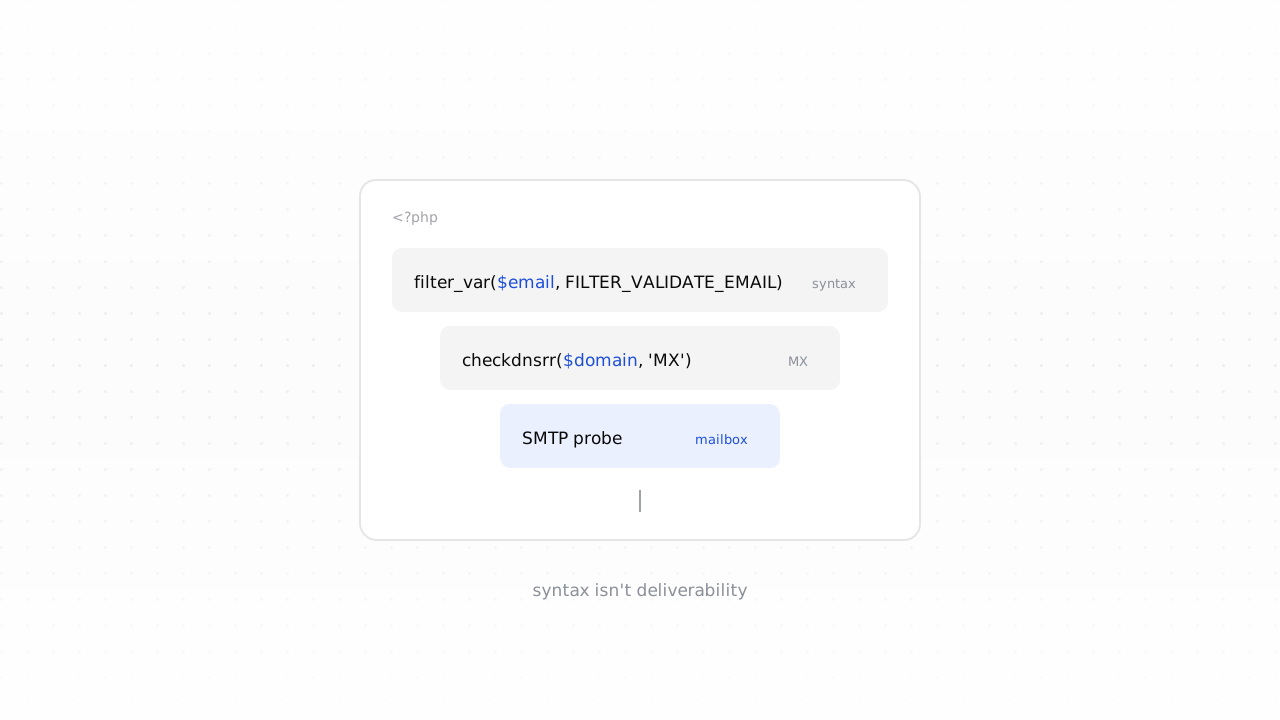
POST /verify returns the local checks (syntax, DNS, disposable, role, typo)
immediately with the SMTP probe queued, and you poll GET /jobs/{id} for the
confirmed result. Be wary of any API that promises a synchronous, instant
"valid/invalid" for every address — that speed usually comes from guessing on the
addresses a real probe couldn't resolve in time.
3. Bulk, and how results come back#
For a list you want asynchronous processing and a way to be told when it's done.
The two patterns are polling and webhooks; the good APIs offer both. Qualisend's
POST /verify/bulk takes up to 1,000,000 addresses and accepts a callback_url
for a signed completion webhook — verify the X-Qualisend-Signature
(sha256= + HMAC-SHA256 of the body) before trusting it — or you poll
GET /jobs/{id}?include=results.
4. Retry safety and rate limits#
Networks fail mid-request; your integration must be able to retry without
double-charging or double-processing. Look for an Idempotency-Key header and
clear rate-limit headers. Qualisend replays an idempotent POST (same key +
body) without re-charging credits, and every response carries
X-RateLimit-Remaining; a 429 includes Retry-After.
5. EU data residency#
If you process EU personal data, where verification happens is a compliance fact, not a preference — and this is where vendors genuinely diverge (the table below).
6. Pricing model and a real free tier#
Match the billing to your usage — per-1,000 credit packs for steady volume, pay-as-you-go for spikes — and insist on a free tier that runs the real pipeline so you can benchmark accuracy before committing. A free tier that skips the SMTP probe tells you nothing about the product you'd be paying for.
7. Language coverage#
Copy-paste examples in your stack shorten the integration. Qualisend's reference ships examples in cURL, Python, JavaScript, PHP, Go, Java, and Ruby.
How the verifiers compare#
Every option here has a REST API, so the table grades the criteria that actually differ — data residency, pricing model, free-tier testing, and whether you get a numeric score. Deeper API specifics (webhook signing, idempotency, the async model) vary and aren't uniformly documented, so check each vendor's own reference before building; the per-vendor comparison pages go further on each. For a written walkthrough of moving away from a specific tool, see the alternatives guides for ZeroBounce, NeverBounce, Bouncer, Kickbox, Emailable, DeBounce, Clearout, and Hunter.
| API | EU data | Starting price | Free tier | Score |
|---|---|---|---|---|
| Qualisend | Yes — EU infrastructure | from $6 / 1,000 | 100 (never expire) | 0–100 |
| ZeroBounce | Regional endpoint | $39 / 2,000 | 100 / month | Add-on (1–10) |
| NeverBounce | No — US (ZoomInfo) | $8 / 1,000 | 1,000 (card) | No — codes |
| Kickbox | No — US | $5 / 500 | 100 | Sendex 0–1 |
| Emailable | No — US (GDPR) | from $0.004 / email | 250 | 0–100 |
| DeBounce | Not documented | from $0.00045 / email | 100 (no card) | No — statuses |
| Clearout | Yes — Frankfurt | $21 / 3,000 | 100 | 0–100 |
| Bouncer | Yes — EU-hosted | $8 / 1,000 | 100 | 0–100 + toxicity |
| Hunter | Yes — EU (Belgium) | €49 / mo | 50 / month | 0–100 |
The developer-relevant reads: for EU residency, Qualisend, Bouncer, Clearout, and Hunter process in the EU while NeverBounce, Kickbox, and Emailable are US; NeverBounce and DeBounce return categorical codes without a numeric score, which is fine if you branch on status and a nuisance if you wanted to rank; and the pricing models split between credit packs and pure pay-as-you-go, which matters more than the headline rate once you know your volume shape.
Qualisend's API, concretely#
A single check is one authenticated POST:
curl https://app.qualisend.com/api/v1/verify \
  -H "Authorization: Bearer $QUALISEND_API_KEY" \
  -H "Content-Type: application/json" \
  -d '{"email":"jane@example.com"}'
The Node.js and Python guides show the full verify-and-poll flow, and the serverless signup guide shows verifying at capture.
In the honest spirit of the rest of this site, the trade-offs: the single
/verify is asynchronous for the SMTP result, so if you need the confirmed
mailbox verdict inline you poll the job rather than getting it in one call; and
credits are charged per verification regardless of the outcome, including
unknown results from greylisting servers. If you want an instant synchronous
"valid/invalid" for every address, no honest API can give it to you — but some
will pretend to.
Frequently asked questions#
Is there a free email verification API?#
Most vendors offer a free tier, but they differ in what they run. Qualisend's 100 free credits (no card, never expiring) run the complete pipeline including the SMTP probe, so the free test reflects the real API. Others range from 50–1,000 free checks; a few require a card. Insist the free tier runs the SMTP probe, otherwise you're benchmarking the cheap local checks, not the product.
Should an email verification API be synchronous or asynchronous?#
Asynchronous for the SMTP part, necessarily. Confirming a mailbox is a network round-trip to a third-party server that may greylist or rate-limit the probe, so a truly instant synchronous verdict for every address is a red flag — it means the API is guessing on the slow cases. The right pattern is an immediate local verdict plus an async SMTP result you poll or receive by webhook.
How do I verify a large list through an API?#
Use the bulk endpoint, not a loop of single calls. A bulk job accepts the whole list (Qualisend's takes up to 1,000,000 addresses), processes it asynchronously, and reports completion by polling or a signed webhook — which is both faster and easier on rate limits than firing thousands of individual requests.
Which email verification APIs process data in the EU?#
Of the widely-used verifiers, Qualisend, Bouncer, Clearout, and Hunter process in the EU; ZeroBounce offers a regional endpoint; NeverBounce, Kickbox, and Emailable are US-based. If EU residency is a compliance requirement, confirm the specifics with the vendor in writing before you integrate.
Want to try the API? The free plan includes 100 credits that run the full pipeline, and the reference documents every endpoint with copy-paste examples in seven languages.