

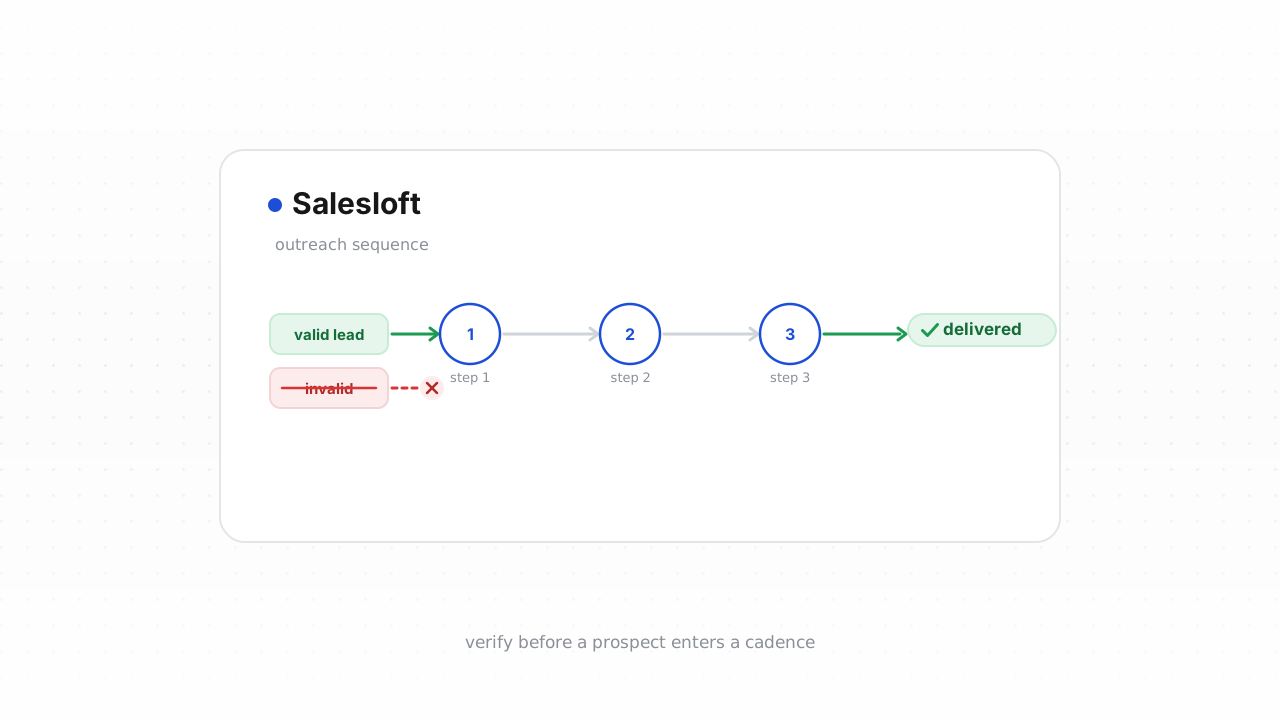
Salesloft is where your cold outreach actually happens: People records, Cadences, and the sending mailboxes wired behind them. It is not where your list gets clean. Salesloft will catch a bounce after it happens and stop hitting that address again, but by then the damage — a bounce logged against your sending domain, a spam-filter that just watched you email a dead mailbox — is already done. For cold email, where you are contacting people who never opted in and every provider is scoring you from the first message, that reactive safety net is not enough. This guide covers what Salesloft's bounce protection does, why you verify independently anyway, and the exact export-verify-hold-out loop that keeps invalid addresses out of a cadence before they ever send.
What Salesloft's bounce protection does#
Salesloft's protection is real, and it works the way most sales-engagement platforms handle deliverability: reactively, after a send.
- Bounces are logged and de-risked. When a message to a Person hard-bounces, Salesloft records the bounce on that Person's record and stops future cadence steps from firing at the same address, so you don't keep hammering a mailbox that already failed.
- Auto-pause on bounce. Salesloft can be configured to automatically pause a Person in their cadence when their email bounces, pulling them out of the sequence instead of continuing to step through it.
- Do Not Contact suppression. Salesloft maintains account-level and per-Person Do Not Contact controls. You can bulk-import a Do Not Contact list and flag individuals so they're excluded from cadences going forward.
Salesloft behavior above last verified against Salesloft's documentation, August 2026.
Credit where it's due — for addresses you've already emailed, this is dependable hygiene. The problem is structural: every one of those mechanisms needs a send and a bounce to fire. The bounce that trains Salesloft to stop is the same bounce that a mailbox provider counts against you.
Why you still verify independently#
Cold email lives or dies on two numbers: your bounce rate and your domain reputation. Unlike a marketing list of opted-in subscribers, a cold prospecting list is assembled from data providers, scrapers, LinkedIn exports, and guessed name-pattern addresses. A large share of it is wrong on arrival, and none of it has ever been mailed — so Salesloft has zero signal on any of it until your first step sends. That first send is exactly when Gmail, Outlook, and every corporate filter form their first impression of your sending domain and mailbox.
The math is unforgiving. Mailbox providers and inbox-placement tools treat a bounce rate above roughly 2–3% as a reputation problem, and cold lists routinely carry 10–30% invalids before cleaning. Push one unverified batch into a cadence and you can blow past the threshold on day one. That's why bounce rate matters so much more in cold outreach than in permission-based email: there's no engagement history to cushion it. A single dirty import can burn a sending domain and mailbox that took weeks to warm up — and once a domain is flagged, even your good prospects land in spam.
Independent verification closes the gap that bounce protection can't. Instead of learning an address is dead by mailing it, you learn before the first step. Qualisend returns one of four verdicts for every address — deliverable, risky, undeliverable, or unknown — each with a reason code, an MX provider, SMTP-probe evidence, and a 0–100 confidence score. Sub-flags call out catch-all domains, disposable addresses, role inboxes, and full mailboxes, so you decide what a cadence never touches. That's the front-line filtering cold-email verification is built for, and it's the piece Salesloft leaves to you.
Step-by-step: export, verify, keep invalids out of the sequence#
The goal is simple: no address enters a cadence until it's been verified. Today the supported path is the CSV loop or the API — the native Salesloft connector is being built and is on the way, but you don't need to wait for it.
1. Export your People from Salesloft. Open the People tab, apply a filter for the segment you're about to prospect (a new import, an untouched account list), select the records, and use the bulk Export action to download a CSV. Verify a segment before you add it to a cadence, not after the first step fires.
2. Verify the CSV with Qualisend. Upload the file to a Qualisend bulk job — jobs handle up to 1,000,000 addresses each, and duplicates are only charged once, which matters on scraped lists that repeat contacts across accounts. You get back every row tagged with its verdict, reason code, sub-flags, and confidence score. If you'd rather not touch a CSV, wire it up through the verification API: scoped keys, rate limits, and webhooks let you validate an address the moment it lands in your data stack, and no-code options via Zapier, Make, and n8n cover the same flow without writing code. New accounts get 100 free one-time credits that never expire, so you can test a real segment before committing.
3. Split the results and act.
- Deliverable → add to the cadence. This is your safe-to-send list.
- Undeliverable → keep them out entirely. Don't import them, or add them to Salesloft's Do Not Contact list so they can't slip into a future cadence.
- Risky (catch-all, full mailbox, low confidence) → hold or throttle. Catch-all domains accept everything at the SMTP layer and can't be confirmed, so keep them in a separate low-volume cadence or a warmed mailbox rather than mixing them into your main send.
- Unknown → re-verify later or exclude; don't gamble reputation on an address the probe couldn't resolve.
4. Import only the clean segment into the cadence. Add the deliverable People to your cadence, or if you import a fresh CSV straight into a cadence, run it through verification first so only clean rows ever get a step. Keep Salesloft's auto-pause-on-bounce turned on as a backstop — it should now almost never fire, because the addresses that would have bounced never made it in.
5. Re-verify on a cadence. Prospect data decays — people change jobs, mailboxes get deactivated. Re-verify long-lived or reused lists every 60–90 days, and always re-run any list that's been sitting since you last cleaned it.
Done consistently, this loop keeps your bounce rate low, protects the domain and mailbox reputation your cold outreach depends on, and turns Salesloft's reactive protection into a last line of defense instead of your only one.
Frequently asked questions#
Does Salesloft verify email addresses before I send?#
Not before — Salesloft's bounce protection is reactive. It logs a bounce after a message fails, stops future cadence steps from hitting that address, and can auto-pause the Person. That protects you from repeatedly mailing a known-dead address, but the first send still happens, and the bounce it produces still counts against your sending domain. Independent verification catches invalid addresses before any step fires.
Does Qualisend have a native Salesloft integration?#
A native Salesloft connector is coming soon — it's actively being built, not deprecated. Until it ships, the supported path is the CSV loop (export People from Salesloft, verify the file in Qualisend, import only clean rows) or the verification API with no-code options via Zapier, Make, and n8n. You can follow progress on the Salesloft integration page.
Can I verify addresses before they ever enter Salesloft?#
Yes, and for cold outreach that's the ideal. Verify at the source — the data provider export, scraper output, or CSV — with a bulk job or the API before importing into Salesloft. That way undeliverable addresses never become People and never enter a cadence, so there's nothing for Salesloft's bounce protection to catch after the fact.
What happens to catch-all addresses?#
Catch-all domains accept mail for any address at the SMTP layer, so no verifier can confirm whether a specific mailbox exists. Qualisend flags these as risky with a catch-all sub-flag rather than guessing. For cold outreach, isolate catch-alls in a separate low-volume or warmed-mailbox cadence instead of mixing them into your primary send.
How often should I re-verify my Salesloft lists?#
Prospect data decays as people change jobs and mailboxes are deactivated, so re-verify long-lived or reused lists every 60–90 days, and always re-run any segment that's been sitting since it was last cleaned. Fresh imports should be verified before they're added to a cadence, every time.