

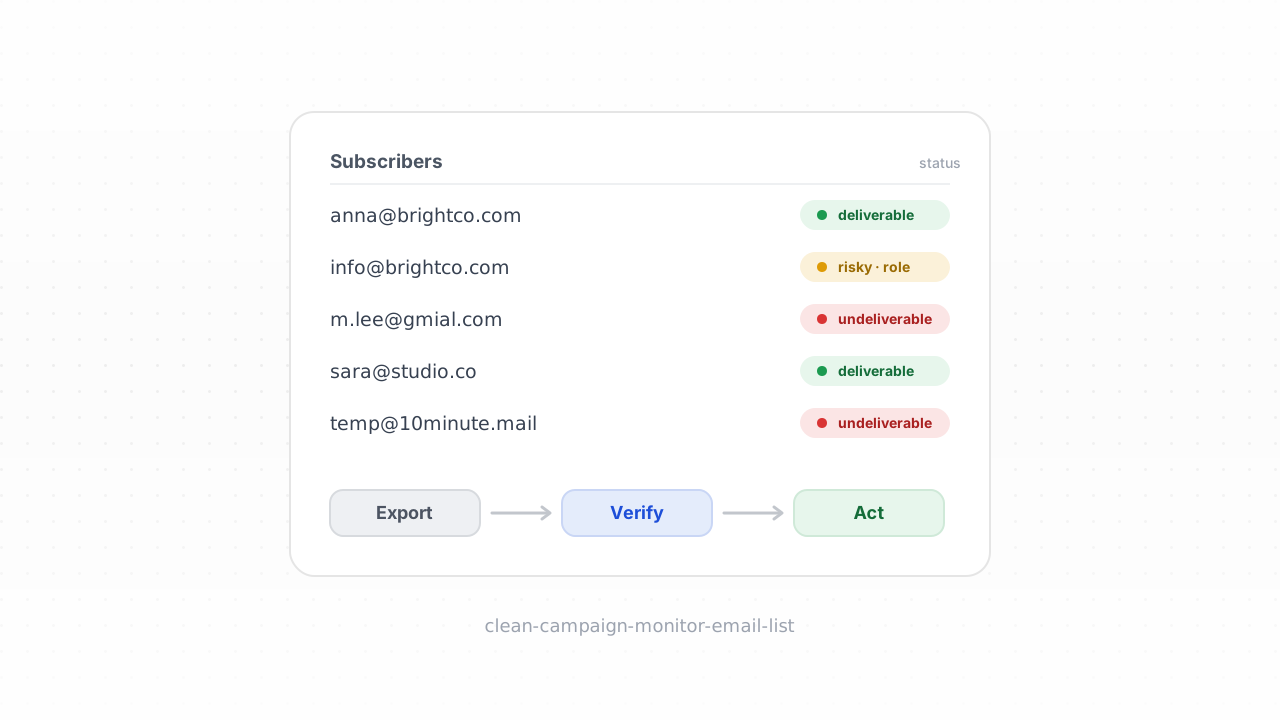
Campaign Monitor is a design-forward ESP, and it keeps its own house in reasonable order: hard bounces and unsubscribes are suppressed automatically, so an address that fails once stops receiving mail. What it can't do is judge an address it has never sent to — the imports, old signups, and typos that sit in your account looking active until the first campaign proves otherwise. This guide covers what Campaign Monitor's suppression does for you, the addresses it can't see, and the export → verify → act loop you run to clean a Campaign Monitor list before your next send.
What Campaign Monitor already does for you#
Campaign Monitor's native hygiene is built around automatic suppression:
- Hard bounces are suppressed automatically. An address that hard-bounces is marked bounced and excluded from future campaigns, so Campaign Monitor won't keep hammering a known-dead mailbox on your behalf.
- Unsubscribes and spam complaints are suppressed too. When someone unsubscribes or reports a campaign, Campaign Monitor adds them to your suppression list automatically so they can't be emailed again — not even by a future import that happens to contain the same address.
- Repeated soft bounces escalate. An address that soft-bounces across several consecutive campaigns is eventually treated as a hard bounce and suppressed. Campaign Monitor doesn't publish an exact threshold, and sensibly so — it varies by mailbox provider.
- Suppression is per-client. A suppressed address generally stays suppressed across the lists within that client, so a bad address you retire in one place doesn't quietly reappear through another list.
Campaign Monitor behavior above last verified against the Campaign Monitor help center, July 2026.
Credit where due: for addresses Campaign Monitor has actually mailed, this is reliable, automatic hygiene. The problem is everything it hasn't mailed yet.
What Campaign Monitor can't catch#
Every mechanism above is reactive — it needs a send and a bounce (or a complaint) to fire. That leaves the blind spot every ESP shares:
- Never-mailed invalid addresses. Subscribers imported from another platform, old form fills, and typos captured at signup have never bounced because they have never been sent to. Campaign Monitor has no signal on them until your first campaign hits them — and that first campaign is exactly where a mailbox provider forms its first impression of you.
- Disposable addresses accepted at signup that were built to expire and will quietly stop existing.
- Role addresses (
info@,support@) that route to a shared inbox and skew the engagement metrics Campaign Monitor's reports and segments lean on. - Decayed addresses that look healthy today and will bounce next month because the person left the company behind them.
An imported list is the sharpest version of this: it arrives with its bounce history amputated, so an address that was already failing on the old platform looks brand new in Campaign Monitor. Confirming a file before it lands is exactly what email verification is for. Verify before the import, not after the first send.
How to clean a Campaign Monitor list: export, verify, act#
The native Campaign Monitor connector is now live: connect it and clean your list in place — Qualisend verifies your contacts and writes the results back, with real-time checks on every new signup. Prefer to work by hand, or on a plan without the connection? The CSV loop below is a valid alternative — the same bulk verification flow as the Mailchimp and Brevo guides, adapted to Campaign Monitor's terms:
- Export from Campaign Monitor. Open the list (or a segment, for a targeted maintenance clean) in your subscriber area and export it to CSV, keeping the email column.
- Verify the file. Upload it to Qualisend bulk cleaning — up to 1,000,000 addresses, duplicates charged once — or paste addresses directly. The free plan's credits cover a first sample so you can see the shape of your list before you commit.
- Read the results. Every address returns
deliverable,risky,undeliverable, orunknownwith a reason code, a 0–100 score, and sub-flags (catch-all, disposable, role, free, full mailbox), plus the MX provider and probe detail as evidence. Download the cleaned CSV. - Retire the undeliverables in Campaign Monitor. Filter your results to
undeliverable, then add those addresses to your suppression list — most accounts let you import a suppression file in bulk — or unsubscribe them so they can never be mailed again. Suppressing keeps the record that the address was bad, which is what stops a future import from silently re-adding it. - Handle everything else per verdict — the table below.
What to do with each verdict#
| Verdict | Campaign Monitor action |
|---|---|
deliverable | Keep sending as normal. |
deliverable + role flag | Keep for transactional and account mail; exclude from engagement-judged automations — see role, disposable & free. |
risky + catch-all flag | Move to a dedicated segment and throttle. A catch-all domain accepts everything at the door, so the mailbox behind it can't be confirmed. |
risky + disposable flag | Add to your suppression list. The inbox was built to expire. |
unknown | Keep active and re-verify next clean — usually a temporary block like greylisting or rate-limiting, not a verdict on the mailbox. |
undeliverable | Suppress (or delete). Don't wait for the bounce to prove it. |
Does cleaning lower your Campaign Monitor bill?#
Campaign Monitor bills by the size of your list on most plans — your active subscribers — while some plans bill by the emails you send. The nuance worth understanding is this: a bounced or unsubscribed address is moved to suppression and typically drops out of your active-subscriber count on its own, so Campaign Monitor's own hygiene already keeps addresses it has mailed off your bill.
The money leak is the never-mailed junk. An imported invalid address has never bounced, so Campaign Monitor still counts it as an active, billable subscriber — and it keeps costing you until a campaign finally bounces it, one or more sends later. Verifying a file before you import it keeps those addresses off your active count from day one, which is why the highest-leverage clean happens before the import, not after the first send.
The bigger payoff is deliverability. Every dead mailbox or spam trap you hit on your next campaign is a bounce or complaint that mailbox providers read as a signal about your sender reputation — and on a shared sending domain, that reputation is what decides whether the subscribers you did earn honestly land in the inbox at all. Cleaning is cheaper than rebuilding a reputation you burned on a dirty import. Reputation is only half the story, though: even a spotless list lands in spam if you haven't authenticated your Campaign Monitor sending domain with SPF, DKIM, and DMARC, the records Gmail and Yahoo now require of bulk senders.
How often to re-clean#
There's no universal number, and we won't invent a decay statistic. The real drivers are how fast your list grows and how it's sourced: a double-opt-in list decays slowly, while one fed by imports and lead magnets accumulates junk continuously. Three habits cover most senders:
- Before any high-stakes send — a launch, a newsletter relaunch, or a seasonal campaign.
- After any import, before the first send touches it — and before those subscribers start counting toward your plan.
- On a regular cycle sized to your volume, with your per-campaign bounce rate as the tripwire between cleans. If bounces climb toward the warning thresholds, clean now (see why bounce rate matters).
Frequently asked questions#
Does cleaning my list lower my Campaign Monitor bill?#
It can, but the mechanism is subtler than "remove the bounces." Campaign Monitor already drops hard-bounced and unsubscribed addresses out of your active count on its own. The addresses that cost you money without earning it are the never-mailed invalid imports, which count as active subscribers until they finally bounce. Verifying a file before you import it — and suppressing the undeliverables you already have — is what keeps that junk off your billable total.
Should I suppress or delete a dead address in Campaign Monitor?#
Suppress it. Adding a verified-undeliverable address to your suppression list stops all future campaigns while keeping the record that the address was bad, which prevents a later import from silently re-adding it. Deleting removes that safety record, so reserve deletion for genuine junk you never want to see again.
Will Campaign Monitor catch a bad address before I send to it?#
No. Campaign Monitor's suppression is reactive — it needs a bounce or a complaint to fire, which means the address has to be mailed first. Imported and freshly captured addresses look active until that first campaign proves otherwise, so the only way to catch them beforehand is to verify the list yourself.
Can I verify addresses before they enter Campaign Monitor?#
Yes, and it's the highest-leverage option: verifying at signup in real time keeps typos and disposable addresses out of Campaign Monitor entirely, so they never become active, billable subscribers in the first place. The native Campaign Monitor connector does exactly this — connect it to check new contacts as they arrive — while the CSV loop above stays a valid path for one-off cleans on any plan.
Clean a Campaign Monitor list the same way every time: export, verify, act. Start with a single address on the free email checker to see the status, score, and reason codes Qualisend returns, then run your full export through bulk cleaning — see pricing for credit packs sized to your list.