

The short answer#
A spam trap is an email address that never opted in to anything and exists only to catch senders with poor list hygiene. Blocklist operators and mailbox providers plant them, then watch who sends to them — because a legitimate, permission-based sender should have no way to acquire the address. Deliver to one and you signal that your list came from scraping, buying, or neglect, which is exactly the behavior blocklists exist to punish. Hitting enough of them can route your mail to spam or get your sending IP or domain blocklisted.
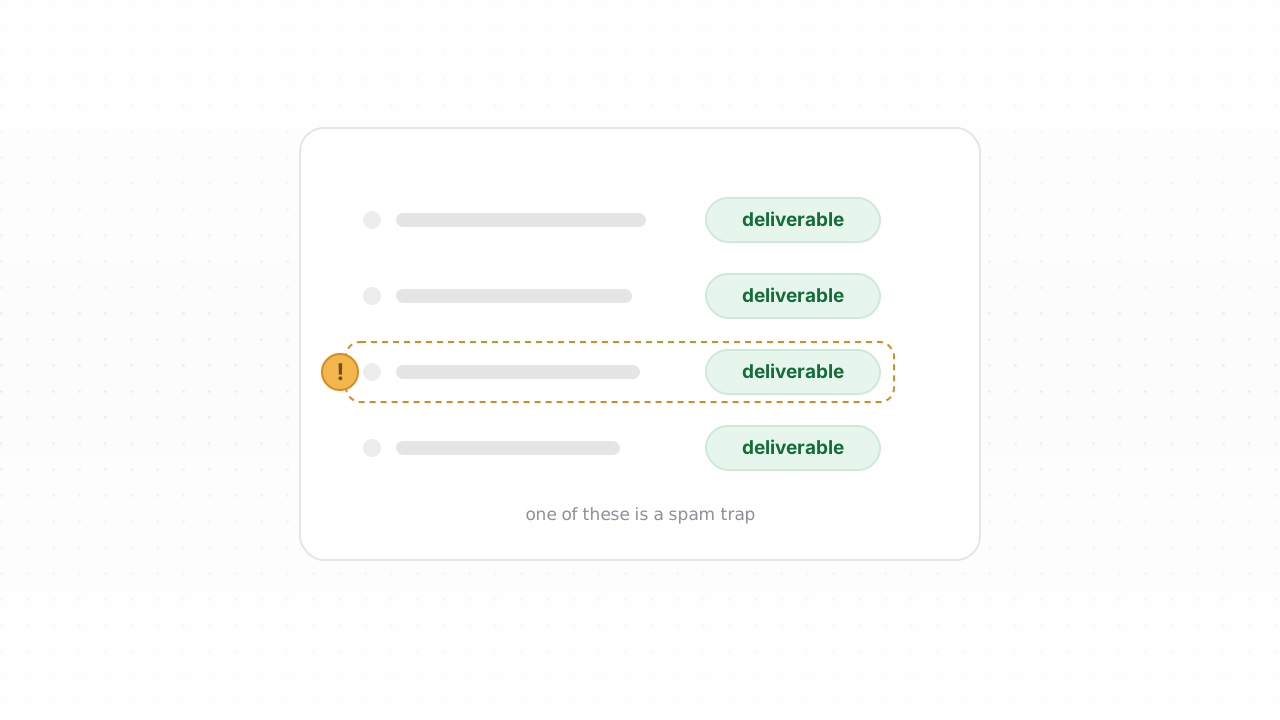
Here is the part most tools won't tell you plainly: no verifier can reliably tell you an address is a spam trap. A live trap accepts mail and looks exactly like a healthy subscriber. Qualisend has no "spam trap" flag, and neither does any honest competitor, because the signal isn't there to read. What verification can do is attack the conditions that put traps on your list in the first place — and that turns out to be the only thing that actually works.
The three kinds of spam trap#
Spamhaus, which operates one of the largest trap networks feeding email blocklists, groups traps into three types. The distinction matters because verification has a different amount of leverage on each.
| Type | What it is | How it lands on your list |
|---|---|---|
| Typo trap | An address at a misspelled provider domain — gmial.com,
yaaho.com, hotnail.com — registered by an
operator to catch mistyped signups. | A subscriber fat-fingers their address at signup and nobody caught the typo. |
| Recycled trap | An address that was once a real mailbox, abandoned, hard-bounced for a long dormancy, then silently reactivated as a trap. | An old address on your list decayed while you kept mailing it. |
| Pristine trap | An address that was never a real mailbox — created purely as bait and seeded where only a harvester would find it (hidden on web pages, in sold lists). | You bought, rented, or scraped a list, or someone added the address to a form to poison your data. |
The recycled type has the most instructive lifecycle. Spamhaus describes it
directly: a decayed address has "all mail to these addresses rejected with a
hard bounce for a period of time, often 12 months or more. After consistently
rejecting mail for a pre-determined period, the addresses are silently turned
back on in the form of spamtraps." That year-plus hard-bounce window is the
opening verification has — more on that below. Trap definitions above last verified July 2026.
Why no verifier can reliably detect a spam trap#
Look at what each trap type does when a verifier probes it, and the problem is obvious.
A recycled trap that has been reactivated accepts mail again — that is the
whole point of turning it back on. To an SMTP probe it answers 250, and the
verdict is deliverable with reason accepted_email. It is, at that moment,
a working mailbox. It just belongs to a blocklist operator instead of a
customer.
A pristine trap is a real, functioning mailbox that also answers 250.
Nothing about the conversation with the mail server distinguishes it from a
legitimate subscriber who happens to have never engaged.
In both cases the trap looks like a healthy address because it is a healthy address. The thing that makes it a trap — that no human at that address ever asked to hear from you — is a fact about how you acquired the address, and it lives entirely outside the SMTP conversation a verifier can see. This is the same wall the catch-all guide runs into from the other direction: verification reports what the mail server will do, and a server that accepts mail cannot report intent that was never expressed to it.
So be suspicious of any product that advertises "spam trap detection" or a
"spam trap score". A full Qualisend result
returns a status, a reason code, and a fixed set of sub-flags — free_mail,
disposable, role, catch_all, full_mailbox, disabled. None of them is
"spam trap", and that omission is deliberate. A tool that manufactures a
trap-probability number is doing the same thing catch-all optimism does: dressing
an unknowable in a confident-looking figure. If a vendor claims to flag traps,
ask which trap type, on which address, and how they know the mailbox owner never
consented — the honest answer is that they don't.
What verification actually does about traps#
"Can't detect them" is not the same as "can't help". Verification has real, specific leverage on the sources of traps, which is where the fight is actually won.
Typo traps: genuinely caught. This is the one category verification removes
head-on. The typo-detection stage compares
each domain against a table of common provider spellings and raises a
did-you-mean suggestion when it sees gmial.com for gmail.com or yaaho.com
for yahoo.com — the exact strings typo traps are registered on. Many of those
misspelled domains also fail the DNS stage outright and come back
undeliverable with reason invalid_domain. Either way, verifying at the point
of capture through the API catches the mistyped address before it
ever enters your list. Even the free checker, which runs
no SMTP probe, includes typo detection — so this protection costs nothing.
Recycled traps: caught during their dead phase. Remember the year-plus
hard-bounce window before a recycled address is reactivated. Throughout that
window the address answers 550 and verifies as undeliverable with reason
rejected_email. If you re-verify your list on a regular cadence and suppress
undeliverables — the loop the
Klaviyo and
Mailchimp cleaning guides walk through — that
address leaves your list while it is still just a dead mailbox, long before it
becomes a trap. Verification can't catch the reactivated trap, but it can stop
the address from surviving on your list long enough to turn into one. The catch
is that this only works if you re-verify repeatedly; a single clean two years
ago does nothing for an address that decayed last month.
Pristine traps: not caught, but starved. A pristine trap is a live mailbox,
so verification will pass it as deliverable — there is no honest way around
that. But pristine traps arrive almost exclusively through list buying, renting,
scraping, and harvesting, and those are precisely the acquisition practices that
the discipline around verification is meant to replace. Verifying at signup only
makes sense if you are collecting addresses from people who typed them in;
adopt that habit and the channel pristine traps travel on closes.
The uncomfortable summary: your strongest protection against traps is behavioral, not a feature. Permission-based collection, never buying lists, and pruning the unengaged do more than any detector could — and the last two, at least, are things verification directly supports.
Why hunting for traps is the wrong goal#
When senders learn they have a trap problem, the instinct is to go find the traps and delete them. Spamhaus, which knows more about traps than anyone selling a scrubber, tells people not to:
We strongly urge people to view spamtraps as proof of a data collection or hygiene issue and not be misled into conducting a hunt for spamtraps. Attempting to locate and remove traps only treats the symptom and not the underlying problem.
The logic is airtight. If a trap reached your list, your collection process has
a hole — you accepted an address a real subscriber never gave you. Deleting the
one trap you found leaves the hole open, and the next trap is already on its way
in through it. Worse, "trap hunting" tools that claim to identify traps are
selling the detection this whole post argues is impossible, which means at best
they catch the typo subset you could catch for free and at worst they invent
verdicts. Fix the intake, measure your hygiene, and the trap problem shrinks as
a side effect. Spamhaus guidance quoted above last verified July 2026.
The list-hygiene playbook that starves traps#
None of these steps "detects" a trap. Together they remove the conditions traps depend on — which, per the section above, is the only durable fix.
- Collect with permission, and confirm it. A confirmed opt-in (the subscriber clicks a link in a confirmation email before they are added) is the single biggest lever, because a trap operator's address can't complete it. This closes the door on pristine traps almost entirely.
- Never buy, rent, or scrape lists. This is the canonical pristine-trap source, and no amount of cleaning afterward makes a bought list safe — you are scrubbing symptoms off a list built the wrong way.
- Verify at the point of capture. Running each address through the API at signup rejects typo-domain traps and dead domains before they enter your list, and flags disposable and role addresses so you can decide what to keep. See free vs paid verification for what the live SMTP probe adds over a browser check.
- Re-verify before major sends and suppress undeliverables. This is what sweeps recycled addresses out during their dead-bounce window, before reactivation. Tie the cadence to your send volume, not the calendar.
- Prune the unengaged. Recycled and pristine traps never open or click, because nobody is reading them. A sunset policy that retires addresses after a long silence sheds traps you can't name — the same reason engagement is the only real confirmation for a catch-all address.
- Watch your bounce rate and blocklist status. A spike in either is often the first visible sign of a hygiene problem, traps included. Keeping bounces low is the same discipline that keeps traps out — see why bounce rate is the metric providers watch.
How spam traps map to verification verdicts#
A trap has no status or flag of its own. It hides inside the ordinary verdicts, which is exactly why it is dangerous — and why the honest move is to show you where it hides rather than pretend to a label we can't support.
| Trap situation | How it verifies | What that means for you |
|---|---|---|
Typo trap (gmial.com) | undeliverable / invalid_domain, or a
did-you-mean suggestion | Caught — the one trap type verification removes directly. |
| Recycled trap, dead phase | undeliverable / rejected_email | Caught if you re-verify and suppress before it reactivates. |
| Recycled trap, reactivated | deliverable / accepted_email | Not caught — it accepts mail like any live mailbox. Engagement pruning is your only defense. |
| Pristine trap | deliverable / accepted_email | Not caught — a real mailbox. Keep it off the list by never acquiring it. |
Compare this with catch-all or disposable addresses, which do get an explicit flag because the mail server's behavior actually reveals them. The absence of a spam-trap flag isn't a gap in the product; it's an accurate report that the signal doesn't exist in the data.
Frequently asked questions#
Can an email verifier detect spam traps?#
Not reliably, and any tool that claims to is overselling. A reactivated recycled
trap and a pristine trap are both live mailboxes that accept mail, so they
verify as deliverable exactly like a real subscriber — the fact that makes
them traps (no consent was ever given) lives outside the SMTP conversation a
verifier can see. The one exception is typo traps on misspelled provider
domains, which verification catches through did-you-mean and DNS checks. For the
other two types, list hygiene, not detection, is the answer.
How do spam traps end up on my list?#
Through the acquisition gaps each trap type is designed to exploit: buying, renting, or scraping lists (pristine traps), letting old addresses decay while you keep mailing them (recycled traps), and accepting mistyped addresses at signup without verification (typo traps). Every one of those traces back to a collection or maintenance process that let in an address no real subscriber gave you with permission.
What happens if I send to a spam trap?#
The trap operator records the hit against your sending IP and domain. A few may cost you nothing, but sustained trap hits are read as strong evidence of poor list hygiene and can get you throttled, filtered to spam, or added to a blocklist that other receivers consult. Because the damage is to your sender reputation, it affects deliverability to your good subscribers too — the same mechanism described in why bounce rate matters.
Should I try to find and remove spam traps from my list?#
No. Spamhaus, which runs a major trap network, explicitly advises against trap hunting: a trap on your list is proof of a hygiene problem, and removing the one you found leaves the process that admitted it untouched. Fix the intake — permission-based collection, verification at capture, and pruning the unengaged — and the trap problem recedes as a consequence.
Does verifying my list remove spam traps?#
Partly, and it is worth doing for the part it reaches. Verification removes typo traps and any recycled trap still in its dead-bounce phase, and it flags the disposable and role addresses that often ride along on a poorly sourced list. It does not remove live pristine or reactivated recycled traps, because those are working mailboxes. Pair regular verification with engagement-based pruning and permission-based collection, and you cover what detection alone cannot.
Want to see the flags a real check returns — and confirm for yourself that none of them is "spam trap"? The free plan includes 100 full verifications with the complete pipeline, SMTP probe and all. For a quick, no-signup look at syntax, DNS, disposable, and typo checks, the free email checker runs in the browser.