

MailerLite's Clean up inactive tool is the button most people reach for when they want a cleaner list — and it is the one that quietly misleads them. It retires subscribers who stopped opening your emails, which is a judgement about engagement, not about whether an address is real. A dead mailbox that never got a single campaign has no engagement history to fail, so it walks straight past the inactive filter — while still sitting in your Active count as a billable subscriber. Cleaning up the disengaged and verifying the invalid are two different jobs, and MailerLite only does the first.
This guide draws that line. It covers the hygiene MailerLite genuinely handles for you, why the inactive tool is not verification, the addresses that slip past both, and the export → verify → act loop that catches them before your next campaign.
What MailerLite already does for you#
MailerLite's native hygiene runs on subscriber statuses:
- Hard bounces are removed automatically. A subscriber that hard-bounces is moved out of your Active list into the Bounced status so it receives no future campaigns — MailerLite does this for you, no manual step required.
- Repeated soft bounces escalate. A subscriber that soft-bounces three times in a row is treated as a hard bounce and moved to Bounced.
- Bounced and unsubscribed don't count toward billing. Your plan is priced on your Active subscriber count; Bounced and Unsubscribed subscribers are excluded, so MailerLite's own cleaning never inflates your bill.
MailerLite behavior above last verified against the MailerLite help center, July 2026.
That is genuinely good automatic hygiene for addresses MailerLite has mailed. But two gaps remain, and the second one catches people out.
What MailerLite can't catch#
The first gap is the one every ESP shares — bounce handling is reactive, so it never touches an address you haven't sent to yet:
- Never-mailed invalid addresses from imports, old signups, and typos, which have never bounced because they have never been sent to.
- Disposable addresses accepted at signup that will quietly stop existing.
- Role addresses (
info@,support@) that skew engagement metrics. - Decayed addresses that look healthy today and will bounce next month.
The second gap is specific to MailerLite. Its Clean up inactive tool retires subscribers based on engagement — by default, those inactive for six months who have received more than ten emails. That is useful, but it is not verification: a never-mailed invalid address has received zero emails, so it sails straight past the inactive-cleanup filter while still counting as an Active, billable subscriber. Engagement cleanup and validity cleanup are different jobs.
Step-by-step: export, verify, act#
The native MailerLite connector is now live, so you can connect it and clean your list in place — verify and write results back, with real-time checks on new contacts. The CSV loop below stays a valid manual alternative on any plan — the same flow as the Klaviyo and Mailchimp guides, in MailerLite's terms:
- Export from MailerLite. Open Subscribers, filter to the group you want to clean, and export it to CSV.
- Verify the file. Upload it to Qualisend bulk cleaning — up to 1,000,000 addresses, duplicates charged once — or paste addresses directly. The free plan's 100 credits cover a first sample.
- Read the results. Every address returns
deliverable,risky,undeliverable, orunknownwith a reason code and sub-flags (catch-all, disposable, role, full mailbox), plus the MX provider and probe detail as evidence. Download the cleaned CSV. - Retire the undeliverables in MailerLite. Filter your results to
undeliverable, then delete those subscribers or move them to Unsubscribed — either way they leave your Active count, which is the count MailerLite bills on. This catches the invalids that hard-bounce handling never reached because you hadn't mailed them yet. - Handle everything else per verdict — the table below.
What to do with each verdict#
| Verdict | MailerLite action |
|---|---|
deliverable | Keep as an active subscriber. |
deliverable + role flag | Keep for transactional content; exclude from engagement-judged automations — see role, disposable & free. |
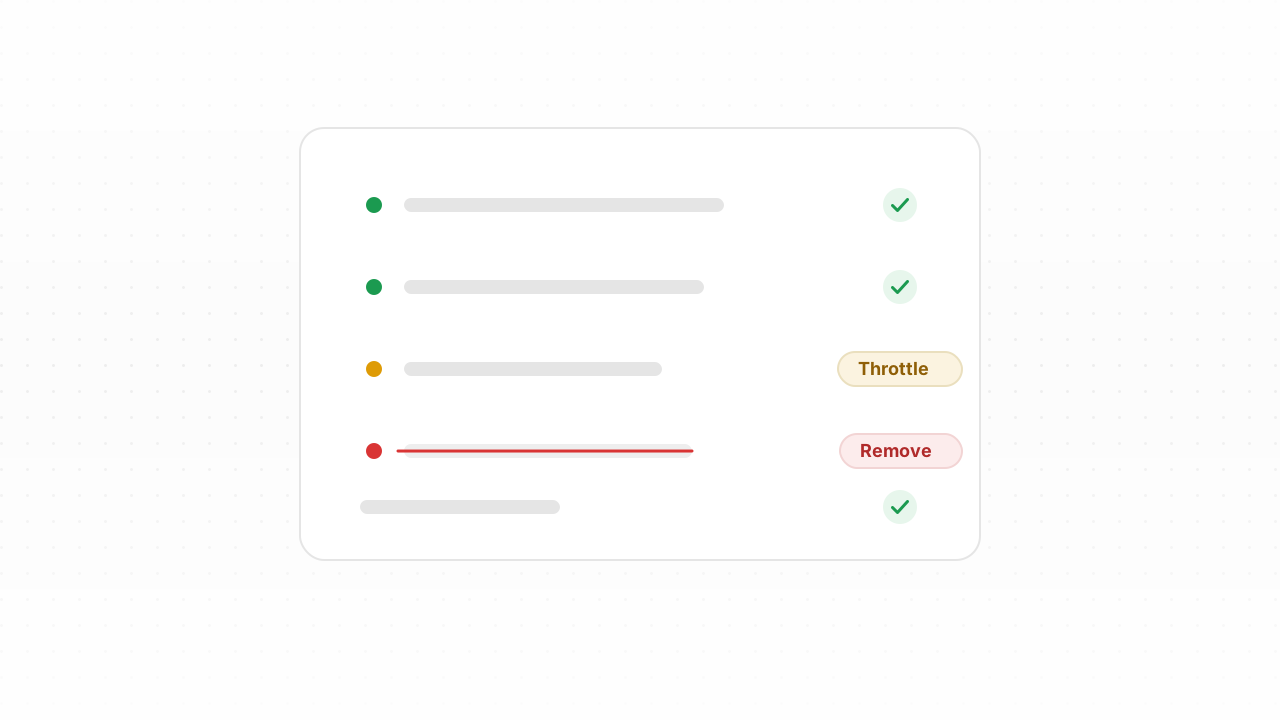
risky + catch-all flag | Move to a dedicated group and throttle — see the catch-all guide. |
risky + disposable flag | Delete or unsubscribe. The inbox was built to expire. |
unknown | Keep active and re-verify next clean — greylisting or rate-limiting, not a verdict on the mailbox. |
undeliverable | Delete or unsubscribe. Don't wait for the bounce to prove it. |
Clean-up-inactive is not verification#
It is worth being clear about the difference, because MailerLite's inactive tool is easy to mistake for a full clean. The inactive tool asks has this subscriber stopped engaging? — it retires people who received your emails and went quiet. Verification asks a different question: is this address real and deliverable at all? The two barely overlap. A typo captured last week is fully deliverable- looking to the inactive tool (it has no engagement history to judge) yet is a guaranteed hard bounce; a never-mailed import is invisible to it entirely. Run the inactive tool to prune the disengaged, and verify to remove the invalid — you need both.
How often to re-clean#
There is no universal number, and we won't invent a decay statistic. The real drivers are how fast your list grows and how it is sourced: a double-opt-in list decays slowly, while one fed by imports and pop-ups accumulates junk continuously. Three habits cover most senders:
- Before any high-stakes send — a launch or seasonal campaign.
- After any import, before the first send touches it — and before those addresses count as Active subscribers.
- On a regular cycle sized to your volume, with your per-campaign bounce rate as the tripwire. If bounces climb toward the warning thresholds, clean now (see why bounce rate matters).
Cleaning is only half of inbox placement, though: even a spotless list lands in spam until you've authenticated your MailerLite sending domain with SPF, DKIM, and DMARC.
Frequently asked questions#
Does cleaning my list lower my MailerLite bill?#
It can. MailerLite bills on your Active subscriber count, and dead never-mailed addresses sit there as Active until something removes them. Deleting or unsubscribing your verified undeliverables takes them off the Active count. Hard-bounced and unsubscribed subscribers are already excluded from billing, so the saving comes specifically from the invalids MailerLite hasn't mailed yet.
Doesn't MailerLite already remove bounced subscribers?#
Yes — hard bounces are moved to the Bounced status automatically and are not billed. But that only applies to addresses you have already sent to and that actually bounced. Never-mailed invalids from an import have never bounced, so they remain Active and billable until you verify and remove them.
Is the Clean up inactive tool the same as verification?#
No. The inactive tool retires subscribers by engagement — by default, those inactive for six months who received more than ten emails. Verification checks whether an address is valid and deliverable at all, including addresses with no sending history that the inactive filter can't see. Use the inactive tool for the disengaged and verification for the invalid.
Can I verify addresses before they enter MailerLite?#
Yes, and it is the highest-leverage option: verifying at signup through the API keeps typos and disposable addresses out of MailerLite entirely, so they never become Active subscribers. The native MailerLite connector is live too, checking new contacts in real time; the CSV loop above remains a valid manual path.