

The short answer#
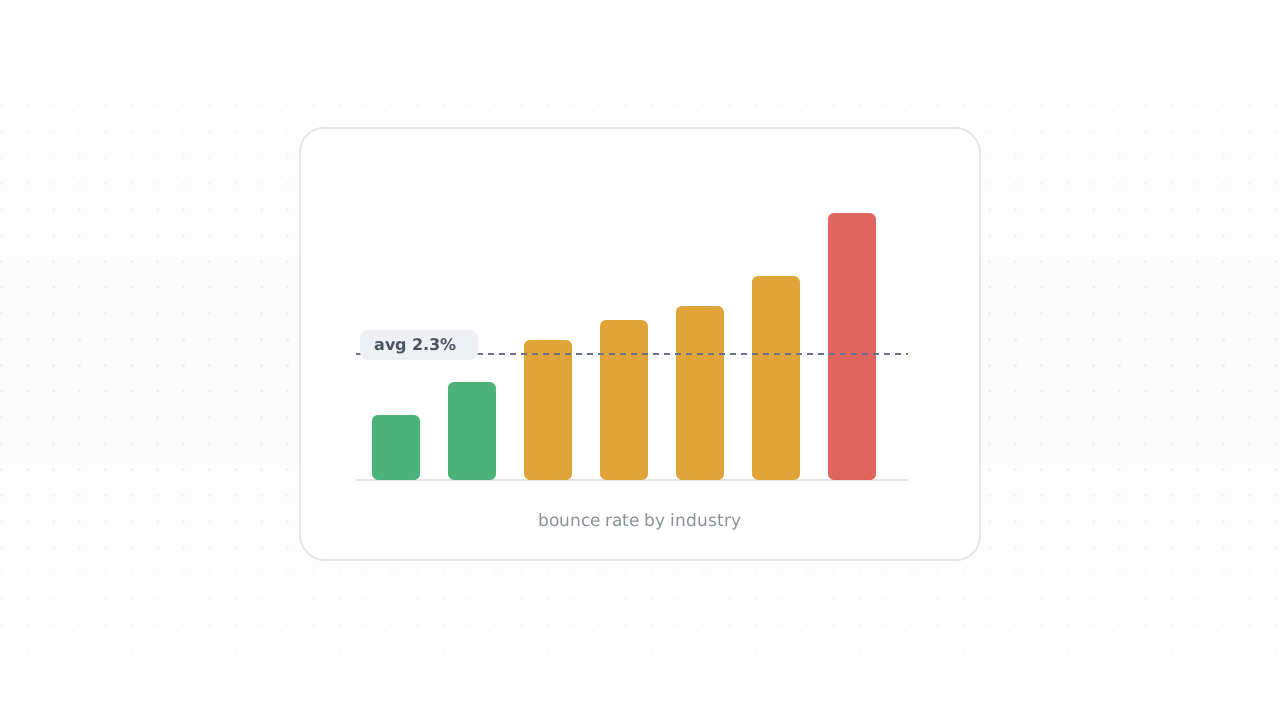
Your email bounce rate is the share of the messages you sent that the receiving servers refused to accept. Across all industries the average is 2.33%, according to GetResponse's benchmark report, which measured more than 4.4 billion messages sent in 2023. The working rule of thumb: under 2% is healthy, 2–5% is worth watching, and above 5% risks getting your mail throttled or filtered.
Two honest caveats sit on top of that number. First, "normal" varies a lot by
industry — a 3% rate is unremarkable for real estate and alarming for a
financial-services sender. Second, and more important: bounce rate is a
lagging readout of your list hygiene, not a dial you turn directly. You lower
it by fixing how addresses get onto your list and how you maintain them, and the
rate follows. Benchmark figures on this page last verified July 2026.
How to calculate your bounce rate#
The formula is simple:
bounce rate = (bounced emails ÷ emails sent) × 100
Send 10,000 emails, have 233 bounce, and your bounce rate is 2.33% — right at the industry average. One thing to keep consistent: some email platforms divide by delivered rather than sent, which nudges the number up slightly. Either denominator is fine as long as you use the same one every time, because what you care about is the trend, not a single decimal.
Bands: under 2% healthy, 2–5% worth watching, over 5% risky. These are rules of thumb, not hard lines — the number that matters is your own rate over time, not a single send against an industry average.
Bounce rate benchmarks by industry#
Here is the full industry breakdown from the GetResponse data. Read it as context, not a target — every figure is an average across senders with wildly different list hygiene, so merely "beating the average" is a low bar.
| Industry | Average bounce rate |
|---|---|
| Communications | 1.19% |
| Financial services | 1.79% |
| Publishing | 2.13% |
| Internet marketing | 2.16% |
| Technology & high tech | 2.23% |
| Non-profits | 2.31% |
| Legal services | 2.39% |
| Retail | 2.55% |
| Education | 2.60% |
| Restaurants & food | 2.68% |
| Travel | 2.90% |
| Health & beauty | 3.06% |
| Arts & entertainment | 3.11% |
| Agencies | 3.15% |
| Health care | 3.17% |
| Sports & activities | 3.71% |
| Automotive | 4.31% |
| Real estate | 4.86% |
The spread tracks how the lists are built. Communications and financial-services lists tend to be permission-based and freshly collected, so they bounce least. Real estate and automotive sit at the top because their lists churn hard — addresses collected at open houses and dealerships, high contact turnover, and a lot of business domains that go catch-all or disappear. If your own rate is well above your industry's line, the list is telling you where it came from.
Hard bounces vs soft bounces#
Not all bounces cost you the same. The distinction that actually matters for your reputation is permanent versus temporary.
A hard bounce is a permanent rejection: the address doesn't exist, the
mailbox was deleted, or the domain has no mail route. On the wire it is a
5xx SMTP response like 550 5.1.1 user unknown,
and a verifier reports it as undeliverable with reason rejected_email or
invalid_domain. Hard bounces are the ones mailbox providers weight heavily,
because a sender who keeps mailing dead addresses looks like someone working from
a stale or purchased list — which is exactly
why bounce rate is the metric providers watch.
A soft bounce is a temporary failure: a full mailbox, a server hiccup, a
greylisting deferral, or a content/policy block. On
the wire it is a 4xx response, and it maps to unknown (reason timeout) or
risky (with the full_mailbox flag) rather than a death sentence. Mail
platforms retry soft bounces automatically for a while, and only escalate an
address to suppressed after it soft-bounces repeatedly.
| Bounce type | Wire signal | Verifier verdict | What to do |
|---|---|---|---|
| Hard bounce | 5xx (e.g. 550 5.1.1) | undeliverable / rejected_email | Suppress permanently — it will never deliver. |
| Soft bounce | 4xx (e.g. 452, 451) | unknown / timeout or risky +
full-mailbox | Retry later; suppress only after repeated failures. |
The practical upshot: aim to drive your hard-bounce rate close to zero, because that is the reputation-damaging component and the one verification can remove before you ever hit send. Soft bounces you manage over time.
What a high bounce rate is actually telling you#
A bounce rate is a symptom. When it climbs, the cause is almost always upstream, in how the list was built or maintained:
- List decay. People change jobs and corporate addresses die constantly, so any list loses deliverability the longer it sits unmailed and unverified.
- Typos at signup. A mistyped
gmial.comis a guaranteed hard bounce — and a spam-trap risk — that a check at the point of capture would have caught. - Purchased or scraped lists. These arrive pre-loaded with dead addresses, spam traps, and catch-all domains. No amount of cleaning makes a bought list safe.
- Catch-all optimism. If a previous verifier rounded unconfirmable catch-all addresses up to "valid", the ones that never existed surface later as bounces.
- No verification at capture. Every address that enters your list unchecked is a bounce you chose not to prevent.
A sudden spike, in particular, almost always traces to one event — a freshly imported list, a long-dormant segment mailed after months of silence, or a batch bought from a broker. It is rarely the sending platform's fault.
How to bring your bounce rate down#
None of this is clever. It is the same boring discipline every honest deliverability guide lands on, mapped to what each step actually removes:
- Verify at the point of capture. Running each address through the API at signup rejects invalid syntax, dead domains, and typo domains before they ever count against you — the cheapest bounce to prevent is one that never enters the list.
- Re-clean before major sends, and suppress the undeliverables. This is the export → verify → suppress loop the Klaviyo and Mailchimp guides walk through, and it is what removes addresses that decayed since you last checked.
- Segment catch-alls, don't blast them. Unconfirmable addresses go in their own throttled segment so their bounces stay contained and measurable rather than polluting your main sends.
- Never buy or rent lists. The single fastest way to a high bounce rate and a blocklisting.
- Prune the unengaged. Addresses that never open or click are the ones most likely to have quietly decayed; a sunset policy sheds them before they bounce.
- Watch the hard-bounce rate specifically. It is the component that moves your reputation, so track it separately from the softer, self-healing failures.
Why zero bounces isn't the goal#
Chasing a literal 0% is a trap of its own. Some bounce is structural: addresses decay in the gap between your last verification and your next send, and catch-all domains will always surface a few addresses that never existed no matter how carefully you verified. A sender reporting a flat 0% over time is usually over-suppressing — treating every unknown and every catch-all as invalid and deleting real, reachable subscribers to make a dashboard look clean.
The honest target is low and stable: hard bounces near zero, soft bounces understood and managed, and the overall rate trending down as your hygiene improves — not a single perfect campaign. Unknown is not invalid, and a subscriber you can still reach is worth more than a tidier number.
Frequently asked questions#
What is a good email bounce rate?#
Under 2% is the widely used healthy threshold, and the cross-industry average is 2.33%, so "average" already sits in the zone worth watching. A better way to frame it: your hard-bounce rate should be near zero, since that is the component that damages sender reputation, while some soft bounces are normal and self-healing. Compare yourself against your own trend and your industry's line rather than a single universal number.
How do I calculate my email bounce rate?#
Divide the number of bounced emails by the number you sent and multiply by 100:
(bounces ÷ sent) × 100. Send 10,000 and have 233 bounce, and your rate is
2.33%. Some platforms divide by delivered rather than sent, which raises the
figure slightly — pick one denominator and use it consistently so the trend is
comparable run to run.
What's the difference between a hard bounce and a soft bounce?#
A hard bounce is permanent — the address or domain doesn't exist, signalled by a 5xx SMTP response, and it should be suppressed immediately. A soft bounce is temporary — a full mailbox, a greylisting deferral, or a server issue, signalled by a 4xx response — and it is worth retrying before you give up on the address. Hard bounces are the ones that hurt your reputation; soft bounces mostly resolve themselves.
Does email verification reduce bounce rate?#
Yes, for the bounces it can see coming. Verification removes invalid syntax, dead domains, and known-undeliverable mailboxes before you send, which eliminates the hard bounces that damage your reputation most. What it can't remove are addresses that decay after you verify them and the genuinely unconfirmable slice on catch-all domains — which is why verification pairs with segmentation and engagement pruning rather than replacing them.
What causes a sudden spike in bounce rate?#
Almost always a single upstream event: a freshly imported or purchased list, a long-dormant segment mailed after months of silence, or a form that started accepting unverified addresses. When your rate jumps, look at what changed about your list just before the send — not at the sending platform.
Want to know your list's real bounce risk before you send? The free plan includes 100 full verifications that run the complete pipeline, so you can suppress the dead addresses first. For a quick, no-signup check of syntax, DNS, disposable, and typo issues, the free email checker runs in the browser.