

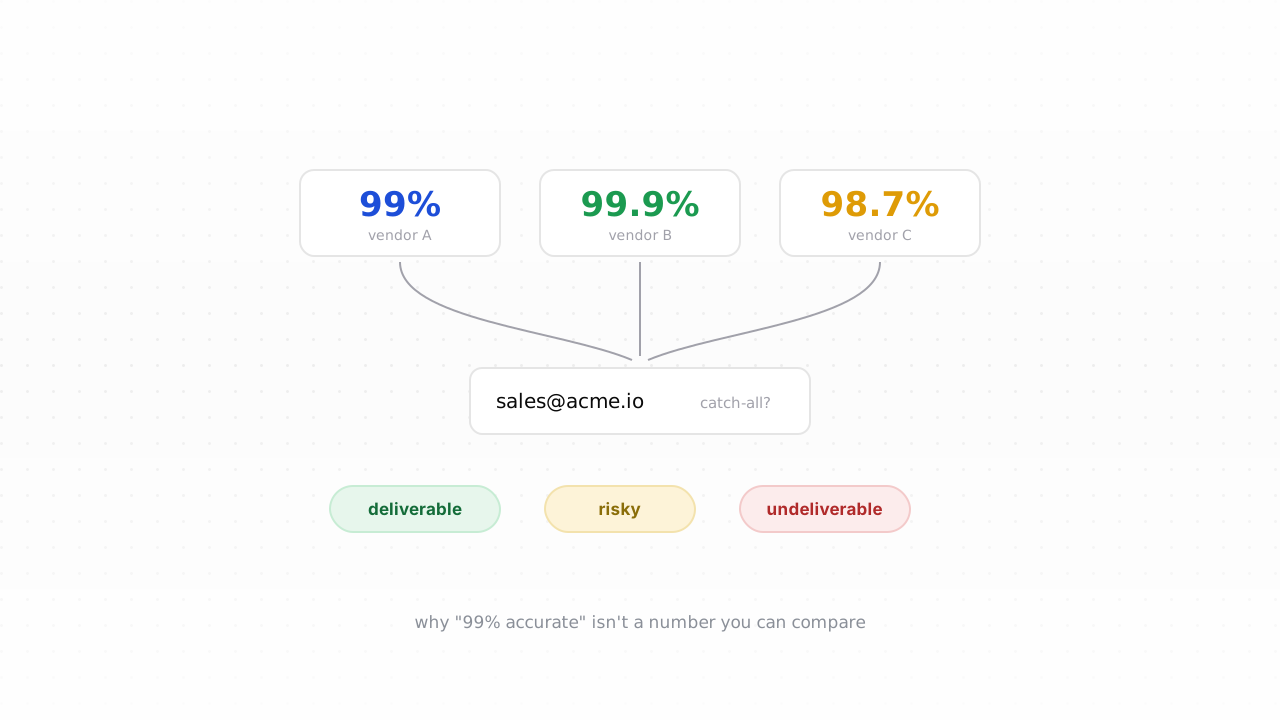
Every email verification vendor's homepage carries a number: "99% accurate," "99.9% accurate," "the most accurate verification on the market." Those figures are the first thing you see and the last thing you should trust. Email verification accuracy is a real, measurable property — but the headline percentages splashed across landing pages are marketing artifacts, not comparable benchmarks, because no two vendors define a "correct" answer the same way, handle the same hard cases identically, or measure themselves on the same list. This guide unpacks what accuracy actually means for a verifier, which mechanical checks determine whether a verdict is right, why some addresses can never be answered with certainty, and the one test that tells you the truth for your list rather than someone's marketing team's.
What email verification accuracy actually measures#
Strip away the marketing and accuracy has a precise meaning: of the verdicts a tool returns, how often does reality agree? An address the verifier called deliverable should accept your mail; one it called undeliverable should bounce. When the verdict and the outcome match, that's a hit. When they don't — a "deliverable" that hard-bounces, or an "undeliverable" that would actually have delivered — that's a miss.
Two kinds of miss matter, and they cost you differently. A false positive is an address marked deliverable that bounces anyway; it slips a bad address into your send and does the exact damage verification was supposed to prevent. A false negative is a good address marked undeliverable or risky and dropped; it costs you a real subscriber, a real lead, or a real customer you'll never email again. A single "accuracy" percentage collapses both of these into one number, which is the first reason it tells you so little — a tool tuned to avoid one kind of miss almost always makes more of the other.
Why vendor "99%+ accuracy" claims aren't comparable#
Take two vendors, each claiming "99% accuracy," and you still cannot conclude they perform the same — or even that either number means what you'd assume. Three things make the claims incommensurable.
They define a "hit" differently. One vendor might count only its confident deliverable/undeliverable verdicts and quietly exclude every address it couldn't resolve. Another might fold "unknown" results into the denominator, or count a correctly-flagged risky address as a hit. Move the boundary of what counts as a gradeable answer and the same underlying performance produces wildly different percentages.
They handle the hard cases differently. The addresses that decide real accuracy are the ambiguous ones — catch-all domains, greylisting servers, temporary failures. A vendor that aggressively guesses "deliverable" on catch-all domains will look more decisive and can claim a higher headline number, right up until those addresses bounce on your send. A vendor that honestly returns "risky" for the same domains looks less impressive on paper and protects you better in practice. The number rewards the wrong behavior.
They measure on self-selected samples. A "99%" figure is only as meaningful as the list it was computed on, and vendors compute it on lists they choose. Benchmark against a corpus that's mostly clean, well-formed Gmail and Outlook addresses and almost any competent tool scores near-perfect. Your list — with its abandoned inboxes, corporate catch-alls, typo domains, and years-old signups — is nothing like that curated sample. Accuracy is a property of the tool and the list together, so a number produced on someone else's list doesn't transfer to yours.
The components that actually determine correctness#
A verdict is only as good as the checks behind it, and each stage of the verification pipeline has a different ceiling on what it can prove. Understanding those ceilings tells you where accuracy comes from — and where it runs out.
Syntax and RFC checks are deterministic. Is the string a structurally valid
address — one @, a sane local part, a plausible domain? This never guesses
wrong, but it also proves almost nothing about deliverability: perfect spelling
is not a real mailbox.
Domain and MX existence is another lookup that either resolves or doesn't. A domain with no mail-exchange record can't receive mail for anyone, so a failure here is a rock-solid undeliverable. A pass, on the other hand, only means the domain could accept mail — not that your specific mailbox exists.
The SMTP mailbox probe is where real confirmation happens, and where the limits bite. The verifier opens a connection to the domain's mail server and runs the delivery conversation up to the recipient check, then disconnects without sending anything. When a server gives a clean accept or reject, that's the strongest signal available. But servers don't always cooperate: some reject every probe regardless of the mailbox, some rate-limit or block verification traffic, and some are simply down at check time. The probe's accuracy is capped by the honesty and availability of the far-end server.
Catch-all (accept-all) domains are the single biggest hole in any accuracy
claim. A catch-all server accepts mail for every address at the domain, real
or invented, so the SMTP probe's "accepted" answer is meaningless — the server
would accept asdkjh8f7@ too. A definitive deliverable verdict is
impossible here by construction, no matter how good the tool is. An honest
verifier returns risky and explains why; the full mechanics are in the
catch-all email explainer.
Greylisting and temporary failures muddy the picture further. Many servers deliberately return a temporary error to unknown senders on first contact, expecting a legitimate mailer to retry. A verifier that treats that soft rejection as a hard "undeliverable" produces a false negative; one that treats it as "deliverable" produces a false positive. The correct answer is often "unknown, retry later" — accurate precisely because it declines to guess.
Role, disposable, and free detection are classification signals rather than
existence checks. A support@ role address, a ten-minute disposable inbox, and
a free-provider mailbox can all be perfectly deliverable — the flag describes
what kind of address it is, not whether it exists. Treating these flags as
correctness is a common way to misread a verifier; the send-or-suppress decision
for each is its own judgment call, covered in
role, disposable, and free addresses.
The unavoidable unknown and risky bucket#
Put those limits together and a conclusion follows that no vendor likes to advertise: some addresses cannot be resolved to a confident yes or no, ever, by anyone. A catch-all domain won't reveal whether the mailbox exists. A greylisting server won't answer on the first try. A temporarily unreachable mail host can't answer at all. For these, the honest verdicts are risky and unknown — and their existence is a sign of accuracy, not a lack of it.
This is the tell that separates a trustworthy verifier from a confident one. A tool that forces every address into deliverable or undeliverable has simply moved its errors somewhere you can't see them: the catch-all it called "deliverable" becomes your bounce, the greylisted address it called "undeliverable" becomes your lost customer. A verifier that returns a calibrated 0–100 confidence score and an honest risky/unknown bucket is handing you the uncertainty to act on, instead of laundering it into a false verdict. The size of that bucket depends far more on your list — how many corporate catch-alls and stubborn servers it contains — than on the tool.
Accuracy vs recall: the tradeoff every verifier makes#
Because the hard cases are genuinely ambiguous, every verifier has to choose how aggressively to rule. That choice is a dial, not a fact, and it trades two goods against each other.
| Verdict style | What it does well | What it costs you |
|---|---|---|
| Aggressive (rules decisively on ambiguous addresses) | Cuts bounces hard — few bad addresses slip through | Over-rejects: real, reachable people get dropped as a side effect |
| Cautious (flags ambiguous addresses risky/unknown) | Keeps more reachable addresses in play | Lets some genuinely bad addresses through to bounce |
Neither dial setting is "more accurate" in the abstract — they optimize for different mistakes. A cold-outreach sender guarding a fragile sender reputation may want the aggressive setting, accepting some lost-contact false negatives to keep bounces near zero. An e-commerce brand emailing paying customers may want the cautious setting, tolerating a slightly higher bounce rate rather than silently dropping real buyers. The right choice depends on which error is more expensive to you — which is exactly the decision a single accuracy percentage can't make for you. Weighing that tradeoff against your own send is the core of how to choose an email verification service.
The only reliable way to judge accuracy: test on your own list#
Since accuracy lives in the tool-and-list pair, there's exactly one way to measure the number that matters: run the verifier on a sample of your own addresses, actually send to them, and compare the verdicts to what really happened. Vendor benchmarks can't do this for you, because they don't have your list. Here is the honest test.
Pull a representative sample. Take a few thousand addresses that mirror your real list — the same mix of old and new, consumer and corporate, hand-typed and imported. A sample skewed toward fresh, clean addresses will flatter every tool and teach you nothing.
Verify, then send for real. Run the sample through the verifier and record each status and confidence score. Then send an actual campaign to it (or a segment you were going to mail anyway) and capture the delivery results — every bounce, with its code.
Correlate verdicts with outcomes. This is the whole test. Split the bounces into hard and soft using email bounce classification, then line them up against the verdicts. Deliverable addresses that hard-bounced are false positives. Undeliverable addresses that would have delivered are false negatives you can spot-check. A good verifier concentrates the hard bounces in its undeliverable and risky buckets and keeps them scarce among the deliverables.
Read the result against real benchmarks. A raw bounce count means nothing in isolation — judge it against typical ranges in the email bounce rate benchmarks, and remember why bounce rate matters in the first place: the whole point of the verifier is to keep that rate low enough to protect your inbox placement. If the tool's deliverable verdicts bounce well within normal ranges, it's accurate for your list — the only accuracy claim worth anything.
Frequently asked questions#
Is any email verification service 100% accurate?#
No, and any tool claiming otherwise is overselling. Some addresses are genuinely unresolvable: catch-all domains accept every address so a mailbox can't be confirmed, greylisting servers refuse to answer on first contact, and some mail hosts are simply unreachable at check time. An honest verifier returns these as risky or unknown rather than guessing. Perfect accuracy would require the far-end mail server to always answer truthfully, which it doesn't.
Why do two verifiers give different results for the same address?#
Because they made different choices on an ambiguous case. The address is likely a catch-all, greylisted, or on a server that rate-limits probes — situations with no single correct answer available over SMTP. One tool guesses deliverable, another returns risky, and a third says unknown. The disagreement isn't a bug; it reflects how aggressively each verifier rules on addresses that can't be confirmed, which is a design decision rather than a factual error.
How do I actually compare accuracy between tools?#
Test them on your own list, not on their benchmarks. Take a representative sample of your addresses, run it through each tool, then send a real campaign and record the bounces. Correlate each tool's verdicts with the actual outcomes — deliverable addresses that hard-bounced are the misses that matter. Whichever tool best concentrates real bounces in its undeliverable and risky buckets, while keeping your deliverable addresses genuinely deliverable, is the most accurate one for you.
Does a high confidence score mean an address definitely exists?#
Not with certainty — it means the verifier found strong signals and few red flags. A confidence score orders addresses by how safe they look, which is useful for prioritizing borderline cases, but it's a probability, not a guarantee. An address can score high and still bounce if the mailbox was abandoned between verification and send, or if the domain quietly accepts everything. Treat the score as a graded risk signal, and re-verify before major sends since addresses decay over time.
The best benchmark is the one you run yourself: paste an address into the free email checker to see the status, reason code, and confidence score a real verdict carries, then verify a sample of your own list and correlate it with an actual send — that's the only accuracy figure that means anything for the mail you're about to send.