

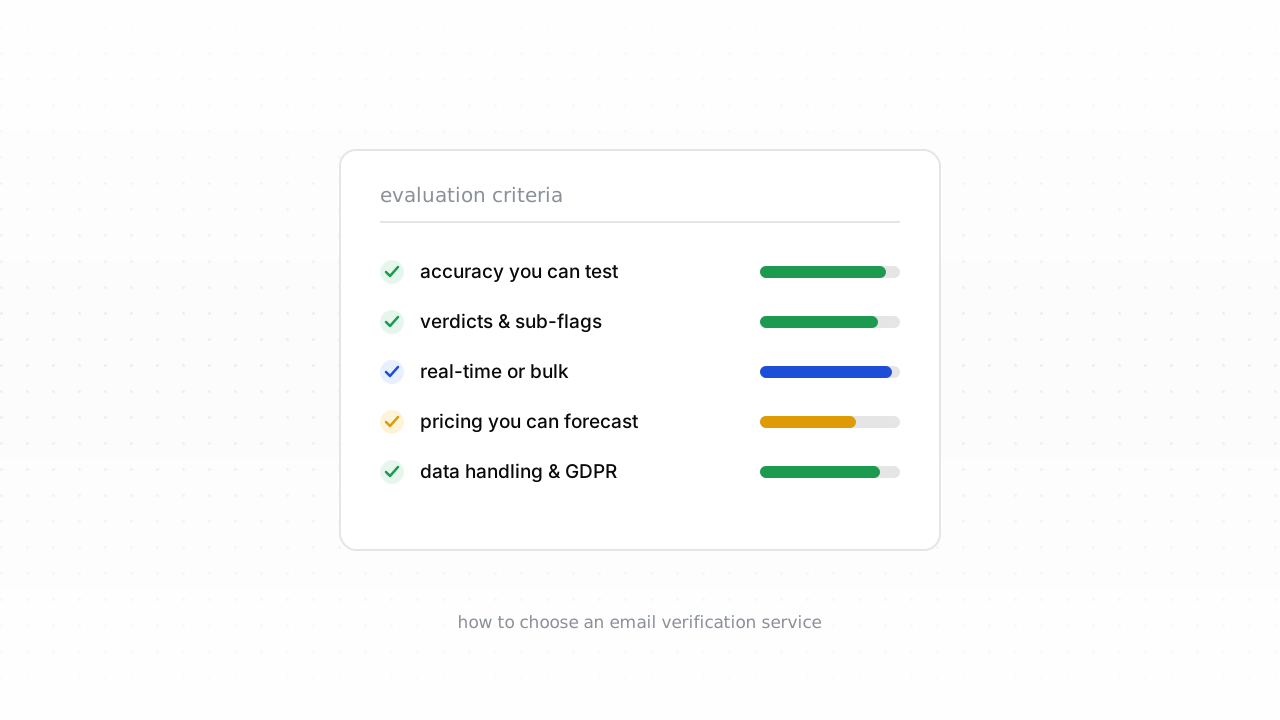
Every email verification tool markets itself the same way: a big accuracy percentage, a wall of logos, and a promise to protect your sender reputation. That sameness is exactly what makes the decision hard. Learning how to choose an email verification service is less about hunting for the vendor with the highest headline number and more about knowing which questions actually predict whether a tool will keep your bounce rate low — on your list, in your workflow. This guide walks the criteria that matter: accuracy you can verify, verdicts you can act on, the right delivery model, pricing you can forecast, and data handling you can defend. The goal is to leave you able to run your own evaluation instead of trusting a sales page.
Start by naming what you actually need#
Two questions frame every decision below. First, where do you capture addresses — a signup form, a checkout, a lead magnet, an existing CRM export, a dormant list you inherited? Second, what will you do with each result — block it, warn the user, suppress it from a campaign, or just store a score? A tool that's perfect for cleaning a stale list once a quarter can be the wrong fit for gating a checkout in real time, and the reverse is just as true.
Write those two answers down before you read a single feature page. They turn a vague "which verifier is best?" into a shortlist you can actually score. If the terminology is still fuzzy, the primer on what email verification is covers the basics; everything from here on assumes you know you need one and are choosing between them.
Accuracy, and why "99%+" is not a spec#
Almost every vendor advertises an accuracy figure in the high nineties, and those numbers are essentially not comparable to each other. The reason is that there is no shared definition of "accuracy" in this field. One vendor measures against a seed set it curated itself. Another excludes catch-all and unknown results from the denominator, so the addresses that are genuinely hard to judge never count against the score. A third treats a "risky" verdict as correct whenever the address turns out to be either good or bad. Each of those is a defensible choice, and each produces a different headline — which is precisely why you can't line the numbers up and pick the biggest.
The only accuracy figure that means anything is the one measured on your data. The honest test is a bake-off: assemble a seed list from your own history and check how each tool's verdicts correlate with what actually happened when you mailed those addresses — did the "undeliverable" ones really bounce, did the "deliverable" ones really land? The full method, including how to read catch-all and unknown results without fooling yourself, is laid out in the guide to email verification accuracy. Treat any single percentage on a pricing page as marketing, not measurement.
What the verdicts and sub-flags actually mean#
A verdict you can't act on is just noise, so look closely at what each tool returns. The useful shape is more than a bare valid/invalid: a status (deliverable, risky, undeliverable, or unknown), a machine-readable reason code, a confidence score, and a set of sub-flags describing the kind of address. The four-state status matters because reality isn't binary — some addresses are genuinely uncertain, and a good verifier says "unknown" instead of guessing "valid" and handing you a bounce.
The interesting differences between tools live at the edges. Pay attention to how a service labels catch-all domains — domains that accept mail for every possible address, so a mailbox can never be truly confirmed — and whether it breaks out role, disposable, and free addresses as separate sub-flags. Sub-flags are what let you make the send-or-suppress call rather than having the vendor bury the decision inside a single verdict.
| Sub-flag | What it marks | The decision it informs |
|---|---|---|
| Catch-all | Domain accepts everything, so the mailbox can't be confirmed | Send with caution, or hold from high-stakes campaigns |
| Role | Shared inbox like info@ or sales@ | Often suppress for marketing; may keep for B2B outreach |
| Disposable | Throwaway or ten-minute-mail provider | Usually block at signup |
| Free | Consumer provider such as Gmail or Outlook | Rarely a problem; useful for B2B segmentation |
How to choose an email verification service for where you capture addresses#
This is the criterion buyers skip most often, and it decides more than any accuracy claim. Verification comes in two delivery shapes, and the right one depends entirely on where addresses enter your world.
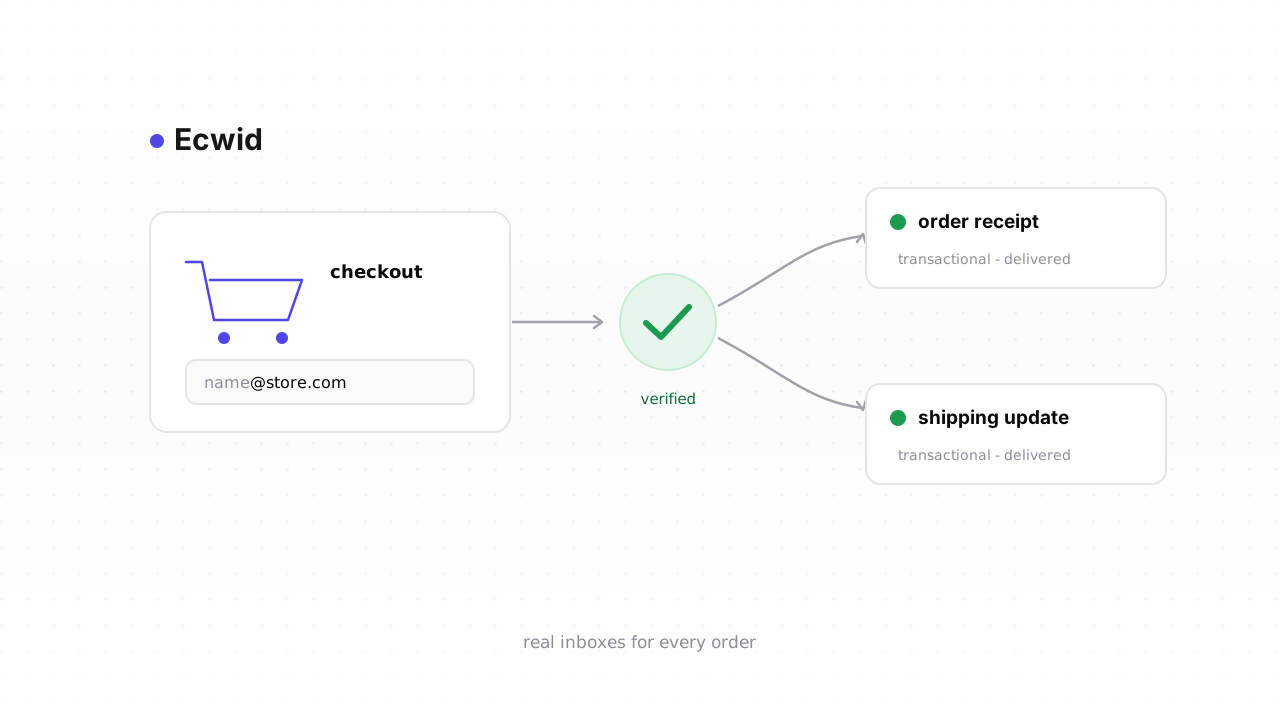
Real-time, over an API. If you capture addresses at a signup form or checkout, you want to verify in that instant and act before the junk lands in your database — reject an obvious typo, suggest a correction, wave a clean address through. That means an API you can call from your stack; the pattern for doing it at the point of capture is walked through in verify email at signup.
Bulk, from a CSV or list sync. If you already hold a list — or you're about to re-engage a dormant segment — you upload it and verify every address at once, asynchronously, then suppress what comes back bad. The end-to-end flow lives in the guide to bulk email verification.
Most teams eventually need both, so check that a single account and one credit pool cover the API and bulk uploads rather than forcing you into separate products. And if developers will own the integration, evaluate the API on its own terms — authentication, scoped keys, response format, rate limits, error handling. The email verification API comparison covers what separates a pleasant API from a painful one.
Speed and reliability for at-signup use#
The moment verification sits in front of a form, latency and uptime stop being technical footnotes and become UX and revenue. A check that takes several seconds adds friction to every signup; a service that's down can silently block conversions. Ask about typical response time in qualitative terms, and ask the question vendors like less: what does your integration do when the verifier is slow or unavailable? Deciding in advance whether to fail open (let the signup through unverified) or fail closed (hold it) is the difference between a graceful degradation and a broken form.
A public status page with a real incident history tells you more than any uptime figure printed on a marketing page. Reliability you can inspect beats reliability you're asked to assume.
Integrations and workflow fit#
The most accurate verdict in the world is worthless if it can't reach the place you act on it. Score each candidate on how it plugs into what you already run: native connectors for your email platform or CRM, or at least a clean CSV round-trip that preserves the reason code and score; an API with scoped keys so a single integration gets least-privilege access; and webhooks or callbacks so long bulk jobs notify you instead of making you poll. Look for results that write back with their sub-flags and reason codes intact, so your own automations can branch on the specific cause rather than a coarse verdict. Clear developer documentation is the tell here — if the docs are thin, the integration will be too.
Pricing models, decoded#
Pricing is where comparison shopping gets slippery, because vendors package the same underlying service in different shapes. Rather than chasing a per-address rate, understand the model and match it to how you buy. (We're deliberately not quoting any competitor's prices here — they change, and a number without its terms is meaningless.)
| Model | How it works | What to check |
|---|---|---|
| Pay-as-you-go | A unit rate for each address checked | Whether unknowns, duplicates, and re-checks are billed |
| Prepaid credits | Buy a block up front, draw it down as you verify | Whether credits expire and how overages are handled |
| Subscription | A monthly or annual quota, sometimes tiered with API access | Whether unused quota rolls over, and the penalty for going over |
| Free tier | A small allowance to trial the real pipeline | How many credits, and whether it runs the SMTP probe or only local checks |
The details in that right-hand column are where budgets go quietly wrong. A low unit rate that bills you for every duplicate and every "unknown" retry can cost more than a higher rate that doesn't. Credits that expire in 30 days punish teams that verify in bursts. A free tier that only runs local checks can't actually validate the tool's core claim. Read the terms, then map them to your real volume before comparing headline prices; the Qualisend pricing page is a useful reference point for what non-expiring credits and a full-pipeline free tier look like.
Compliance and data handling#
Uploading a list means handing a third party the personal data of real people, which puts this squarely in GDPR (and similar) territory. Before you send a single address, get clear answers on: whether there's a Data Processing Agreement; where addresses are processed and stored, and whether EU data residency is available; how long addresses are retained after a job completes; whether your data is ever used to train models or enrich anyone else's results; and who the subprocessors are. A vendor that answers these crisply is telling you it has thought about being a data processor. A vendor that gets vague is telling you something too.
Support and transparency#
Transparency is itself a feature. The trustworthy signals are boring ones: documented reason codes so you know what each verdict means, public developer docs, a status page, support that answers, and — most tellingly — honesty about limits. A service that openly explains that catch-all mailboxes are unconfirmable, that lists decay over time, and that "unknown" is a real and legitimate outcome is more reliable than one selling the fantasy of perfect certainty. Keeping a list clean is ongoing work, tied directly to why bounce rate matters; a vendor that frames it honestly is a better long-term partner.
How to run a fair bake-off#
Everything above resolves into one exercise. Instead of weighing marketing claims, put your two or three finalists through the same test on your own data:
- Build a seed list from your history. Take a sample of addresses you've mailed recently and label them with what actually happened — bounced, delivered, engaged. Salt in a handful of known-good, known-bad, catch-all, role, and disposable addresses so you can see how each type is handled.
- Run the identical list through each tool using its free tier or trial, so you're comparing verdicts on the exact same inputs.
- Score verdicts against reality. Count how often each tool's "undeliverable" matched a real bounce and its "deliverable" matched a real delivery, and note how each treats the catch-alls and unknowns — the cases where tools diverge most.
- Judge the operational fit at the same time: response speed, how the API feels, and how cleanly results export back into your workflow.
When you specifically want a named head-to-head, don't take an anonymous scorecard's word for it — read the detailed comparisons. The Qualisend vs ZeroBounce and Qualisend vs NeverBounce pages, and roundups like ZeroBounce alternatives and NeverBounce alternatives, lay out the trade-offs in the open so you can weigh them against the results of your own bake-off.
Frequently asked questions#
How do I actually compare accuracy between email verification services?#
Not by lining up their advertised percentages — those use different definitions and aren't comparable. Build a seed list from your own history where you already know which addresses bounced and which delivered, run it through each tool, and measure how well their verdicts match reality. The tool whose "undeliverable" best predicts real bounces on your data is the accurate one for you, regardless of whose sales page claims the bigger number.
Do I need real-time verification, bulk cleaning, or both?#
It depends on where you capture addresses. If you're gating signup or checkout forms, you need real-time verification over an API so you can catch bad addresses before they enter your database. If you're cleaning an existing list or re-engaging a dormant segment, you need bulk CSV verification. Most teams end up wanting both, so it's worth choosing a service where one account and one pool of credits cover the API and bulk uploads together.
What should I look for in email verification pricing?#
Match the model — pay-as-you-go, prepaid credits, subscription, or free tier — to how you actually buy, then read the fine print. Check whether unknowns, duplicates, and re-checks are billed, whether credits expire, and whether the free tier runs the full SMTP probe or only local checks. A low unit rate with punitive terms can easily cost more than a higher rate without them, so compare total forecast cost at your real volume, not the headline number.
Is it safe to upload my email list to a verification service?#
It can be, but you're sharing real people's personal data, so due diligence matters. Ask whether the vendor offers a Data Processing Agreement, where it stores and processes addresses, whether EU data residency is available, how long data is retained, and whether your list is ever used to train models or enrich other customers' results. A provider that answers these clearly is treating its data-processor role seriously; vagueness is a reason to walk.
The fastest way to end the guesswork is to test on your own data. Drop a few of your trickiest addresses into the free email checker to see how the statuses and sub-flags read, then run a real sample through the full pipeline with the non-expiring credits on the Qualisend pricing page and compare the verdicts against what actually bounced — the one comparison no marketing page can make for you.