

Outlook and Office 365 are the hardest inboxes to reach and the least willing to tell you why. A message that sails into Gmail can drop straight into the Outlook junk folder from the same campaign, and the bounce — if there even is one — reads like a riddle. Microsoft filters on reputation more than content, and it keeps the scoring deliberately opaque. Here is how that filtering actually works, the two free tools that let you see inside it, and the concrete steps that move your mail back to the inbox.
The short answer#
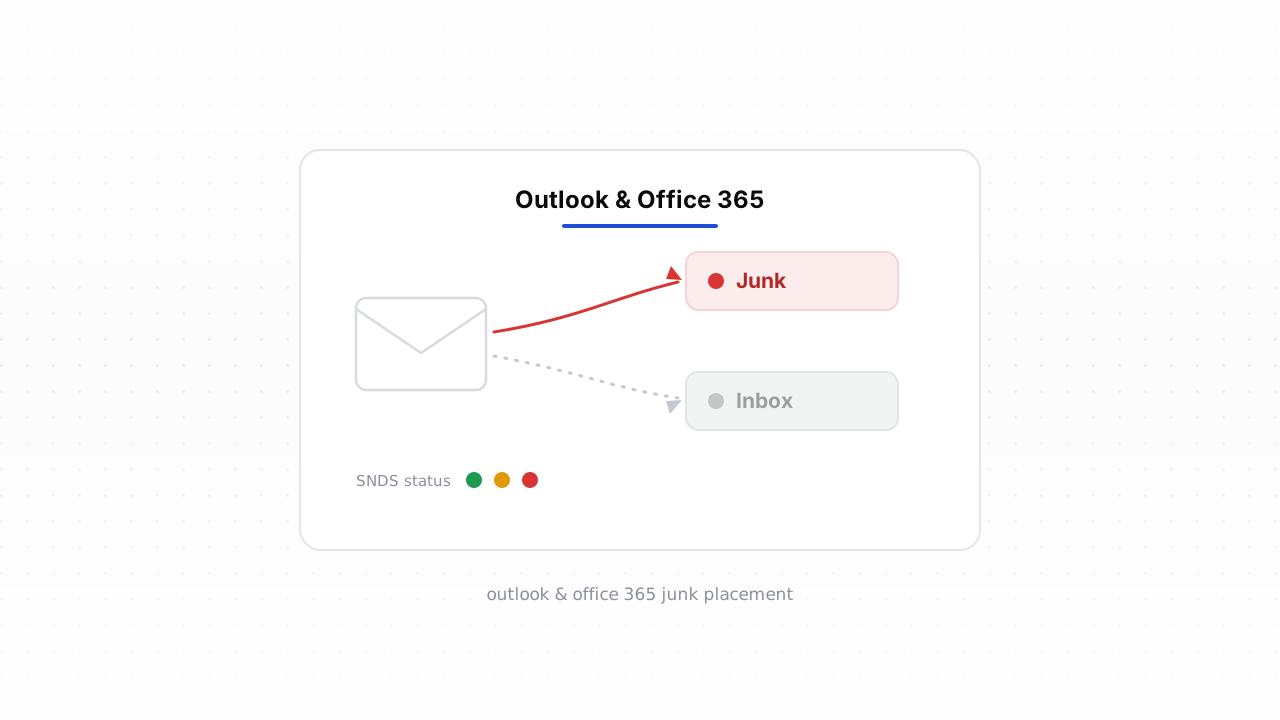
Microsoft routes mail to Outlook and Office 365 junk primarily on the reputation of your sending IP and domain, not on keyword-based content rules. If your messages are landing in junk, the usual causes are a low- or unknown-reputation IP, a sudden jump in volume, spam complaints from Outlook.com users, or missing authentication. The fastest way to diagnose it is to enrol your IPs in Microsoft's Smart Network Data Services (SNDS) and its Junk Mail Reporting Program (JMRP) — the only tools that show you Outlook's own view of your sending — then fix the underlying signal and, if you are genuinely blocked, request mitigation through Microsoft's sender support form.
How Microsoft filters mail#
Microsoft runs two distinct mail systems, and the filtering logic is shared across both:
- Consumer mail — Outlook.com, Hotmail, Live, and MSN addresses.
- Office 365 — business mailboxes protected by Exchange Online Protection (EOP) and Defender for Office 365.
For years the consumer side used a content-scoring engine called SmartScreen. Microsoft retired SmartScreen for email and moved to a reputation-driven model, and EOP works the same way: the filter leans heavily on who is sending rather than what the message says. Your IP reputation, your domain reputation, your authentication results, and your complaint history carry far more weight than the words in the body. This is why swapping out "spam trigger" phrasing rarely rescues an Outlook placement — the decision was mostly made before the content was read.
Microsoft's reputation model is also unusually binary at the edges. A sender with a strong, established history gets consistent inbox placement; a new or unproven IP gets filtered aggressively until it earns trust. There is very little middle ground, and no public score you can watch tick upward the way you can with other providers.
Outlook is stricter and more opaque than Gmail#
If you also send to Gmail, the contrast is stark. Google publishes a fairly clear
picture of how it treats you through Postmaster Tools, and its bounce messages
tend to name the problem. Microsoft does neither well. Its rejections are terse
and generic — a 550 5.7.1 refusal with a support reference code, or a silent
deferral where the message simply never arrives and never bounces. Two things make
Outlook harder to work with:
- New IPs start from a deficit. Microsoft distrusts unproven senders by default, so a freshly warmed IP that Gmail already accepts may still be filtered by Outlook for weeks longer.
- The feedback is thin. Where Gmail hands you reputation ratings and spam rates, Microsoft gives you a delist portal and a support form. You have to go looking for the data, and much of it is inferred rather than stated.
The two tools you should be using: SNDS and JMRP#
Microsoft gives senders two free programs, and using both is the single most useful thing you can do for Outlook.com deliverability. They cover different signals and you should register for both, per sending IP.
| Tool | What it shows | What it is for |
|---|---|---|
| SNDS (Smart Network Data Services) | Per-IP data: message volume, complaint rate, spam-trap hits, and the filter result Outlook assigned your mail (green / yellow / red). | Seeing how Microsoft rates each IP you send from, and catching problems before they turn into blocks. |
| JMRP (Junk Mail Reporting Program) | A complaint feedback loop: when an Outlook.com user marks your mail as junk, Microsoft forwards you a copy so you can suppress that recipient. | Removing complainers immediately, before their reports drag your reputation down. |
SNDS requires you to prove control of the IP range, which means it is aimed at senders on a dedicated IP or their own infrastructure — if you send through a shared-IP ESP, the ESP holds this data, not you. The colour-coded filter status is the closest thing Microsoft offers to a public reputation score, so check it regularly and treat any move toward red as an early warning.
JMRP is a classic complaint feedback loop: you register per IP, receive junk reports, and act on them by suppressing the recipient at once. A complaint is a stronger "stop sending" signal than an unsubscribe, and every one you ignore is another nudge toward the junk folder for everyone else on that IP.
Common reasons your mail lands in Outlook junk#
Most Office 365 and Outlook.com spam problems trace back to a short list of causes, roughly in order of how often they are the culprit:
- Low or unknown IP reputation. A new dedicated IP, or a shared IP with a bad neighbour, is the most common reason. Microsoft filters unproven IPs hard until they build history.
- A sudden spike in volume. Going from a few hundred messages a day to tens of thousands overnight reads as a compromised account or a spam run. Consistent, gradual volume is what Microsoft rewards.
- Spam complaints. Outlook.com users hitting "junk" push your complaint rate up, and Microsoft acts on the rate. Keep it well under the ~0.3% threshold every major provider watches for.
- Missing or misaligned authentication. Without valid SPF, DKIM, and DMARC, Microsoft has no verified identity to attach reputation to — and increasingly no reason to accept the mail at all.
- Poor list hygiene. Dead addresses and Microsoft spam traps sit inside the old, unverified corners of your list. Hitting them is direct evidence of the neglect the filter is built to catch.
- Content and infrastructure mismatches. URL shorteners, mismatched or no-reply From domains, image-heavy messages with little text, and links to low-reputation domains all add friction — secondary to reputation, but they tip borderline cases.
Authentication is now non-negotiable#
The industry-wide bulk-sender rules that Google and Yahoo introduced in 2024 set the baseline Microsoft now expects too: SPF and DKIM in place, a DMARC policy on your domain, functioning one-click unsubscribe on marketing mail, and a complaint rate kept low. Microsoft has since announced comparable requirements for high-volume senders to Outlook.com. If you are not fully authenticated, that is the first thing to fix — not because Outlook is unique in wanting it, but because without it you have no reputation to build on in the first place.
How to request mitigation from Microsoft#
If you have fixed the underlying problem and are still blocked, Microsoft offers two escalation paths. Use them only after the cause is resolved — a delist request on an IP that is still generating complaints will be rejected, and repeated failed requests do you no favours.
- Office 365 (business recipients): use the Microsoft 365 anti-spam IP delist
portal at
sender.office.com. You submit the blocked IP and an email address, and Microsoft either removes the block or explains why it stands. - Outlook.com (consumer recipients): use the Outlook.com deliverability support form (the Sender Support / Sender Information form). Describe your sending practices, confirm your authentication and list-hygiene setup, and request mitigation for the IP.
Neither path is a reset button. Mitigation clears a specific block; it does not rebuild reputation. If the behaviour that caused the block continues, you will be back in junk within days.
Steps to improve Outlook placement#
Pulling it together, here is the order of operations that actually moves mail from the Outlook junk folder to the inbox:
- Authenticate fully. Confirm SPF, DKIM, and DMARC all pass and align. This is the prerequisite for everything else.
- Enrol in SNDS and JMRP for every IP you send from, and start reading the data. You cannot fix what you cannot see.
- Clean your list before you send. Removing dead addresses and likely spam-trap candidates strips out the fastest ways to lose Microsoft's trust.
- Warm up new IPs and domains gradually, and keep your daily volume steady. Microsoft distrusts spikes more than almost any other provider.
- Suppress complainers immediately from JMRP reports, and fix the source of any complaint spike — a bad segment, a misleading subject, or an audience that never really opted in.
- Watch your sender reputation over time, using SNDS as your Outlook signal, and request mitigation only once the numbers are clean.
None of this is quick, and Outlook rewards patience more than any single trick. Steady, authenticated, low-complaint sending to a clean list is what earns the inbox — and holds it.
Frequently asked questions#
Why do my emails go to spam in Outlook but not Gmail?#
Because Microsoft and Google score senders differently and Microsoft starts from more distrust. Outlook and Office 365 lean heavily on IP and domain reputation, and they filter new or unproven IPs aggressively — so an IP Gmail already accepts can still be junked by Outlook for weeks. Microsoft is also stricter about sudden volume changes and gives far less feedback about why, which makes the gap between the two inboxes feel arbitrary when it is really a reputation difference.
What is Microsoft SNDS and do I need it?#
SNDS (Smart Network Data Services) is Microsoft's free program that shows per-IP data for mail sent to Outlook.com and Hotmail: your volume, complaint rate, spam-trap hits, and the filter status Microsoft assigned (green, yellow, or red). It is the closest thing to a public reputation score for Outlook, so yes — enrol if you control your sending IP. If you send through a shared-IP ESP, the ESP holds this data instead of you.
How do I get unblocked by Outlook or Office 365?#
First fix the cause — authentication gaps, complaints, volume spikes, or list quality — because a delist request on an IP that is still misbehaving will be denied. Then, for Office 365 business recipients, submit the blocked IP through the anti-spam IP delist portal at sender.office.com; for Outlook.com consumer recipients, use the Outlook.com deliverability support form. Mitigation clears a specific block but does not rebuild reputation, so the fix has to come first.
Does content or reputation matter more for Outlook deliverability?#
Reputation, by a wide margin. Microsoft retired its old content-scoring engine and filters primarily on the reputation of your sending IP and domain, your authentication results, and your complaint history. Content still matters at the margins — URL shorteners, no-reply domains, and image-heavy messages tip borderline cases — but rewriting copy will not rescue a placement that a low-reputation IP or an unresolved complaint problem already decided.
Most Outlook junk problems start with the signals a clean list controls: dead addresses, spam-trap hits, and the complaints they trigger. Qualisend's free plan runs the full verification pipeline so you can strip those out before Microsoft sees them, and 100 free credits that never expire are enough to clean a list and watch your SNDS status improve.