

An email sending subdomain is a dedicated hostname — something like
mail.example.com, news.example.com, or e.example.com — that you use to send
bulk or marketing mail instead of your root domain. The point is isolation: the
reputation your campaigns build or burn stays on the subdomain, so a single bad
send doesn't drag down the corporate and transactional mail flowing from
example.com itself. This guide covers when a sending subdomain earns its keep,
how the reputation split actually works, how to authenticate it with SPF, DKIM,
and DMARC, and the one caveat that catches everyone: a fresh subdomain starts
with no reputation at all.
The short answer#
Send different types of mail from different subdomains, and keep your root
domain out of the bulk-sending business entirely. A common layout is a
transactional subdomain, a marketing subdomain, and — if you do it — a separate
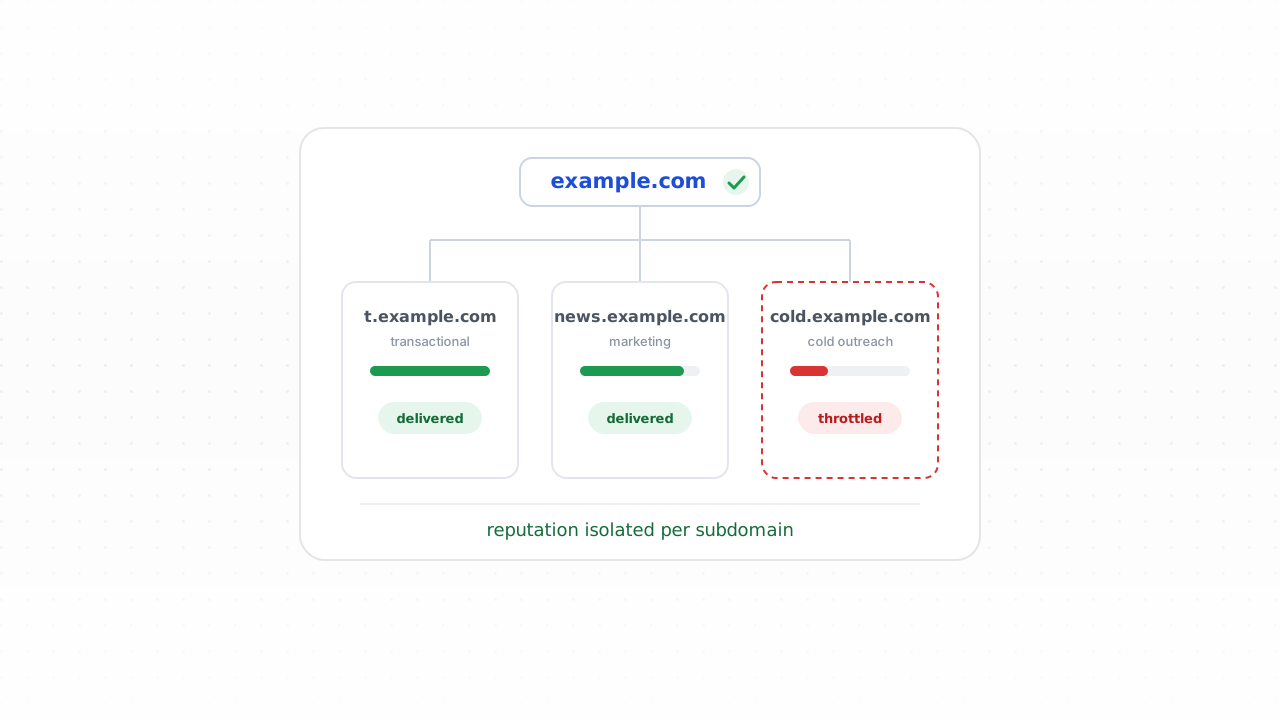
subdomain for cold outreach. Each subdomain carries its own
sender reputation, so a spike in spam
complaints on the marketing stream doesn't follow your password resets and
receipts into the spam folder. Authentication is per-hostname for SPF and DKIM
but can be governed centrally through DMARC's sp= tag. The trade-off: any new
subdomain has to be warmed up before it
can send at volume, because to a mailbox provider it is a stranger.
Why use a dedicated email sending subdomain#
The case for a sending subdomain comes down to blast radius. Mailbox providers
build a reputation profile for the domain in your visible "From" address, and
that profile is one of the biggest inputs to whether your mail lands in the
inbox or spam. If everything you send — transactional receipts, sales outreach,
and a 200,000-recipient newsletter — all leaves from example.com, then those
streams share a single reputation. The newsletter's complaint rate, the cold
campaign's bounces, and the receipts' near-perfect engagement all get blended
into one score.
That blending is fine right up until it isn't. The moment one stream misbehaves
— a list you didn't clean, a re-engagement blast to dormant contacts, a
compromised campaign — the damage lands on every message from that domain. Your
customers stop getting order confirmations because your marketing team mailed a
stale list. Isolating the risky, high-volume mail on its own subdomain contains
the fallout: if news.example.com gets throttled, example.com and your
transactional stream keep flowing.
The protection runs both ways. Corporate mail from your root domain — one-to-one replies, invoices, contracts — is low-volume and high-trust, and you don't want a marketing misstep putting it at risk. Equally, you don't want your bulk sending to be judged against a root domain that has no bulk-sending track record. Splitting the streams lets each build the reputation appropriate to how it's actually used.
How the reputation split actually works#
Providers evaluate reputation at more than one level: the sending IP, the
signing/sending domain, and the broader organizational domain. A subdomain gives
you a distinct sending-domain identity, so news.example.com accrues its own
history of volume, engagement, complaints, and spam-trap hits, largely separate
from example.com.
"Largely" is the honest word here. A subdomain is not a hermetically sealed identity. Providers still associate a subdomain with its parent to some degree — a domain with a genuinely toxic root reputation won't be fully rescued by spinning up a fresh subdomain, and that is by design, to stop spammers from endlessly minting clean-looking hostnames under a burned domain. What a subdomain does reliably give you is a separate reputation surface for well-behaved streams that would otherwise be dragged down by a noisier one under the same roof. Treat it as strong insulation, not a firewall.
Because reputation is anchored to the "From" domain your recipients see, the
subdomain only isolates reputation if you actually send from it — the visible
From: address has to be something@news.example.com, not
something@example.com with the subdomain buried in the return path. If the From
domain is still the root, the root domain is still the one earning the reputation.
A subdomain layout that scales#
There's no single correct scheme, but the durable pattern is to separate by mail type, because different types have fundamentally different risk and engagement profiles:
- Transactional (
t.example.comor similar) — receipts, password resets, shipping notices. Triggered by user action, opened almost universally, and complained about almost never. This stream deserves its own pristine reputation and should never share a subdomain with marketing. - Marketing (
news.example.com,mail.example.com) — newsletters, promotions, product announcements. Higher volume, lower and more variable engagement, the occasional complaint. This is the stream most worth isolating. - Cold outreach (a separate subdomain, or better, a separate domain entirely) — the highest-risk category by far. Cold mail attracts complaints and spam-trap hits, and many senders deliberately keep it off their primary brand domain so a burned outreach reputation can't touch the mail their business depends on.
The important rule is that transactional and marketing never share a reputation. If you do nothing else, split those two. Keeping each stream on its own subdomain also makes diagnosis far easier: when placement drops, your monitoring points at one hostname instead of forcing you to untangle which of several mixed streams caused it. It pairs naturally with keeping every list clean — see how to clean an email list — since isolation limits damage but hygiene is what prevents it.
Authenticating a sending subdomain#
Every sending subdomain needs the full authentication stack — SPF, DKIM, and DMARC — just like a root domain. The catch that trips people up is that these records behave differently when it comes to inheritance. For the concepts behind each record, see the SPF, DKIM, and DMARC explainer; what follows is how they apply specifically to subdomains.
SPF is not inherited. A subdomain does not use its parent's SPF record. If
example.com publishes an SPF record and mail.example.com publishes none, the
subdomain has no SPF policy — the parent's record does not apply. You must
publish a separate SPF TXT record on the subdomain listing whatever service sends
its mail:
mail.example.com. TXT "v=spf1 include:sendgrid.net ~all"
DKIM is published under the subdomain. Your sending platform gives you a
selector, and the public key lives at that selector under the sending
hostname. For mail from mail.example.com the DKIM record sits at, for example:
s1._domainkey.mail.example.com. TXT "v=DKIM1; k=rsa; p=MIGfMA0G..."
Sign with d=mail.example.com so the signing domain matches the From domain and
the message stays DKIM-aligned.
DMARC can be inherited — and this is the useful part. When a receiver checks
DMARC for mail from mail.example.com, it first looks for a record at
_dmarc.mail.example.com. If none exists, it falls back to the organizational
domain's record at _dmarc.example.com and applies the subdomain policy from
the sp= tag if present, otherwise the main p= policy. So a single record at
the org domain can govern every subdomain at once:
_dmarc.example.com. TXT "v=DMARC1; p=reject; sp=reject; rua=mailto:dmarc@example.com"
Here p=reject covers example.com itself and sp=reject covers every
subdomain that lacks its own record. If you want a subdomain to run a different
policy — say, keeping a newly launched sending subdomain at p=none for
monitoring while the root stays at reject — publish a dedicated DMARC record on
that subdomain, which overrides the inherited sp=:
_dmarc.mail.example.com. TXT "v=DMARC1; p=none; rua=mailto:dmarc@example.com"
One more point on alignment. Relaxed alignment (the DMARC default) treats a
subdomain and its parent as the same organizational domain, so DKIM signed as
d=mail.example.com still aligns with a From: of example.com. But since the
whole reason for the subdomain is to send as the subdomain, keep the From
domain, the DKIM d=, and the return-path all on the same hostname — that way
you're aligned under either relaxed or strict rules and the reputation lands
exactly where you intend. If you're not already running DMARC in enforcement,
set up DMARC at the org level first and let sp=
extend the policy to your new sending subdomains.
The warm-up caveat nobody skips#
A brand-new sending subdomain has zero sending history, which means it has no reputation — and no reputation, from a mailbox provider's perspective, is closer to bad than to good. Point a large campaign at a cold subdomain on day one and you invite throttling, bulk-foldering, or outright blocks, precisely because a sudden flood from an unknown hostname is what a spam operation looks like.
So a new subdomain has to be warmed up: start with low daily volume to your most engaged, recently active recipients, and ramp up gradually over several weeks as the subdomain earns a positive track record. Sending to people who open and click teaches providers the subdomain is trustworthy; sending to a stale list teaches them the opposite, and on a fresh subdomain there's no accumulated goodwill to absorb the mistake. This is also why you plan a subdomain migration before you need it — cutting over your entire volume to a new subdomain overnight throws away the warm-up runway and can tank placement for weeks.
The warm-up cost is real but it's a one-time investment, and it's exactly why the isolation is worth it: once each subdomain has its own established reputation, they fail independently. If you're weighing a subdomain move as part of a broader inbox-placement fix, the email deliverability guide covers where it fits among the other levers, and the Google and Yahoo sender requirements spell out the authentication and complaint-rate thresholds every sending hostname now has to clear.
Frequently asked questions#
Should I send marketing email from a subdomain or my main domain?#
From a subdomain, in almost every case. Sending bulk marketing from your root
domain means a bad campaign — a stale list, a complaint spike — damages the
reputation of your transactional and corporate mail too, since they share the
same "From" domain. A dedicated subdomain like news.example.com isolates that
risk so a marketing misstep can't send your receipts and password resets to
spam. The only cost is warming the subdomain up before you send at volume.
Do subdomains inherit SPF and DKIM from the root domain?#
No. SPF and DKIM are not inherited — a subdomain with no SPF record has no SPF
policy at all, regardless of what the parent publishes, and DKIM keys must be
published under the sending hostname (for example
selector._domainkey.mail.example.com). DMARC is the exception: if a subdomain
has no _dmarc record of its own, receivers apply the organizational domain's
policy, using the sp= (subdomain policy) tag if it's set.
What is the DMARC sp tag and when should I use it?#
The sp= tag in your organizational domain's DMARC record sets the policy for
subdomains that don't publish their own DMARC record. For example,
v=DMARC1; p=reject; sp=reject enforces reject on both the root domain and all
its subdomains from one record. Use it to extend a strict policy across every
sending subdomain automatically, and publish a dedicated _dmarc record on an
individual subdomain only when you need it to run a different policy — such as
keeping a freshly launched subdomain at p=none while it warms up.
Does a new sending subdomain need to be warmed up?#
Yes. A new subdomain has no sending history, and to a mailbox provider that blank slate is treated with suspicion rather than trust. Sending high volume from it immediately invites throttling or spam placement. Warm it up by starting with low volume to your most engaged recipients and ramping gradually over several weeks, letting the subdomain build a positive reputation before it carries your full sending load.
A sending subdomain contains the damage from a bad send, but it can't undo the bad send itself — that still comes down to who's on your list. Run your list through the free email checker to strip out dead addresses, typos, and spam traps before they hit any subdomain, so the reputation each one builds is clean from the first campaign.