

Cold email is unforgiving about bounce rate. A hard bounce isn't just a lost prospect — it's a signal to mailbox providers that you're mailing addresses you can't vouch for, and enough of those signals will quietly tank the reputation of a sending domain you spent weeks warming. Lemlist knows this, which is why it ships bounce protection of its own. But that built-in check is a floor, not a ceiling. This guide covers what Lemlist's protection actually does, why cold senders still verify independently, and how to build an export → verify → suppress loop that keeps invalid addresses out of a sequence before they ever cost you a send.
What Lemlist's bounce protection does#
Lemlist runs an email-verification step on the contacts it processes, and it maintains a suppression model so known-bad or opted-out addresses stop receiving mail. When you upload leads or pull them in through Lemlist's own lead-finder, the platform can flag addresses it believes are undeliverable and hold them back from your campaign. It also tracks bounces during a running sequence and stops mailing addresses that fail. On paper, that's real protection — it catches the obvious dead weight before and during a send.
The catch is scope and depth. Lemlist's verification is a convenience layer bundled into a sending tool, not a dedicated verification engine. It tends to catch syntactically broken addresses and clearly dead mailboxes, but it gives you little visibility into the gray middle: catch-all domains that accept every address at the SMTP layer, role accounts like info@ and sales@, disposable domains, and mailboxes that are technically valid but full. For cold outreach, those gray-area addresses are exactly where reputation damage hides. A verifier that returns a simple valid/invalid verdict, with no confidence score and no reason code, can't tell you why an address passed — and on cold lists, "why" is the whole game.
Lemlist behavior above last verified against Lemlist's documentation, August 2026.
Why you still verify independently#
Cold email lives or dies on two numbers: bounce rate and domain reputation. They're linked. Every hard bounce is a vote against your sending domain, and mailbox providers weight those votes heavily for senders with no prior relationship to the recipient — which is every cold prospect by definition. One unverified list, sent in a burst, can push your bounce rate past the threshold where inbox placement collapses. At that point it isn't one campaign that suffers; it's every campaign from that domain and mailbox until you rebuild trust, which can take weeks. That's the asymmetry cold senders have to respect: the downside of a bad send is durable, and the cost of preventing it is a few cents per address. Our email verification for cold email breakdown walks through why the math favors verifying every time, and the cold email deliverability guide covers the reputation side in depth.
Independent verification also gives you the granularity a bundled checker can't. Qualisend returns one of four verdicts for every address — deliverable, risky, undeliverable, or unknown — each with a reason code and sub-flags for catch-all, disposable, role, and free addresses, plus a full-mailbox flag. Each result carries the MX provider, SMTP probe evidence, and a 0–100 confidence score. That detail is what lets you make a real decision on cold leads instead of a coin flip. A catch-all domain that a bundled verifier waves through gets flagged risky with the reason attached, so you can throttle those addresses into a smaller test batch instead of blasting them. If you're mailing recently warmed infrastructure, pairing verification with a proper domain warm-up is what keeps a fresh domain out of trouble — and why bounce rate matters explains exactly how providers score the failures you're trying to avoid.
Step-by-step: export, verify, keep invalids out of the sequence#
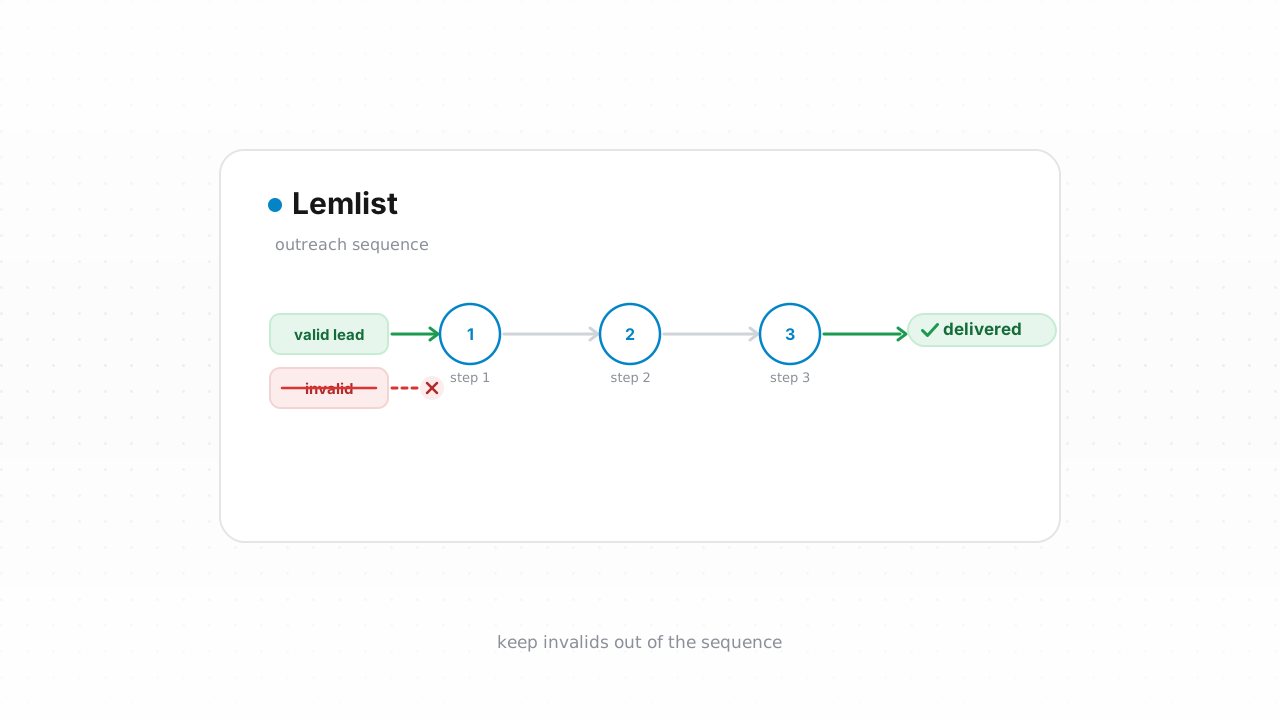
The principle is simple: verify before a prospect enters a sequence, not after. Once a lead is in a running cadence, a bounce has already been sent and already counted. You want the verification gate to sit in front of the campaign.
The fastest path is the native connector. Qualisend's Lemlist integration is live: connect it once and Qualisend cleans your list in place — it verifies your existing Lemlist contacts and writes the verdicts back, and it runs real-time checks on new contacts as they're added, so freshly imported or lead-finder leads get scored before they hit a sequence. That closes the loop without a spreadsheet in the middle. Set it up at /integrations/lemlist.
If you're on a plan or workflow where the connector doesn't fit, the CSV loop works anywhere:
- Export your campaign leads from Lemlist. Pull the leads for the campaign — or the segment about to enter one — into a CSV. Do this before you activate the sequence, or on any batch you've just imported.
- Run the list through Qualisend. Upload the CSV — bulk jobs handle up to 1,000,000 addresses per run, and duplicates are only charged once, so overlapping campaign exports don't cost you twice. You'll get back every row tagged deliverable, risky, undeliverable, or unknown, with reason codes, sub-flags, and confidence scores.
- Split the results by verdict. Keep the deliverable rows for the sequence. Hold the undeliverable rows out entirely — these are the bounces you're preventing. Route risky and unknown rows into a separate, smaller test batch rather than your main push, so catch-all and full-mailbox addresses can't drag your headline bounce rate down.
- Pause or skip invalids inside Lemlist. Back in Lemlist, keep the undeliverable addresses out of the active campaign — pause those leads, remove them from the sequence, or simply don't add them. The goal is that no address Qualisend flagged as undeliverable ever receives a send.
- Re-verify before every new push. Cold lists decay fast, and scraped or purchased leads decay fastest. Re-run each new batch through the same gate before it enters a cadence — verification is a per-send habit, not a one-time cleanup.
Teams that want this fully automated can skip the manual export with Qualisend's Verification API, which returns the same four-verdict result with scoped keys, rate limits, and webhooks, and connects to no-code tools like Zapier, Make, and n8n. A common pattern: trigger verification the moment a lead is created, and only sync deliverable results into the Lemlist campaign. The developers docs cover the endpoints and webhook payloads. For broader context on the placement rules cold senders now have to meet, the email deliverability guide and Google & Yahoo sender rules are worth a read.
You can try the whole loop before committing: Qualisend's free plan includes 100 one-time credits that never expire — enough to verify a real test batch and see the reason codes on your own leads.
Frequently asked questions#
Does Qualisend have a native Lemlist integration?#
Yes. The native Lemlist integration is live. Connect it at /integrations/lemlist and Qualisend cleans your list in place — it verifies your existing Lemlist contacts and writes the verdicts back, and it runs real-time checks on new contacts as they're added. It's the fastest path. If it doesn't fit your plan or workflow, the CSV export-and-verify loop works on any plan.
Should I verify addresses before they enter a Lemlist sequence?#
Yes — verify before a prospect enters a sequence, never after. Once a lead is in a running cadence, any bounce has already been sent and already counted against your domain. Put the verification gate in front of the campaign: verify each batch, keep only deliverable rows, and hold invalids out before you activate the sequence.
Isn't Lemlist's built-in bounce protection enough for cold email?#
It's a helpful floor, not a complete solution. Lemlist catches clearly dead and malformed addresses and stops mailing ones that bounce, but it gives limited visibility into the gray middle — catch-all domains, role accounts, disposables, and full mailboxes — which is exactly where cold-email reputation damage hides. Independent verification adds reason codes, sub-flags, and confidence scores so you can decide on those addresses instead of guessing.
What do Qualisend's verdicts mean for my cold list?#
Every address gets one of four verdicts: deliverable, risky, undeliverable, or unknown — each with a reason code, sub-flags (catch-all, disposable, role, full mailbox), the MX provider, SMTP probe evidence, and a 0–100 confidence score. Send to deliverable, hold undeliverable out entirely, and route risky and unknown into a smaller test batch instead of your main push.
How much does it cost to try this?#
Qualisend's free plan includes 100 one-time credits that never expire, which is enough to verify a real test batch of leads and see the reason codes on your own list. Bulk jobs handle up to 1,000,000 addresses per run and charge duplicates only once, so overlapping campaign exports don't cost you twice.