

Few blocklists generate as much argument as this one. A UCEPROTECT blacklist listing can appear on your report even when your own sending is clean — because UCEPROTECT is built to escalate from a single bad IP to an entire network. It's a German DNSBL operator with three stacked levels, a free way off the first, and a paid "express" removal for the higher two that has earned it a divided reputation. Here's how the three levels actually work, why you might be listed through no direct fault of your own, and how much a UCEPROTECT listing really matters.
The short answer#
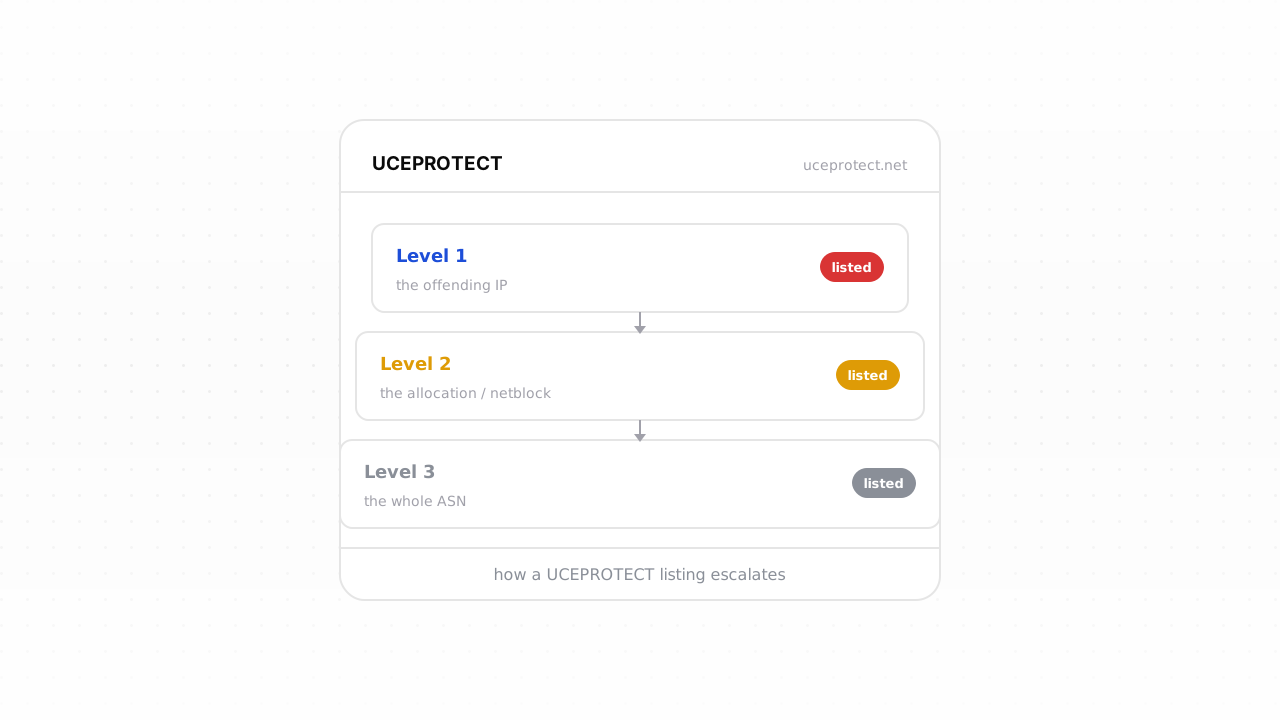
UCEPROTECT is a DNS-based blocklist run out of Germany, queried at uceprotect.net. It's not one list but three escalating levels: Level 1 lists the individual IP that tripped a spam trap, Level 2 lists the broader allocation or netblock that IP lives in, and Level 3 lists an entire autonomous system (ASN) — potentially thousands of unrelated senders sharing the same provider. Level 1 clears for free on its own after a short spam-trap-free window; Levels 2 and 3 exist to pressure networks, and UCEPROTECT sells a paid express-delisting option for senders who don't want to wait. Because that paid model is controversial, many mailbox providers weight UCEPROTECT lightly — so a listing here is usually far less urgent than one on Spamhaus.
The three UCEPROTECT levels, explained honestly#
The defining feature of UCEPROTECT is its escalation model. Most blocklists list the specific IP or domain responsible for spam. UCEPROTECT does that too — and then widens the net deliberately, on the theory that networks tolerating spammers should feel collective pressure to clean house. Whether that's fair is exactly the debate, but the mechanics are straightforward:
| Level | What it lists | Who it catches |
|---|---|---|
| Level 1 | The single offending IP address that hit a UCEPROTECT spam trap. | Only the actual sender responsible. This is the "you did something" list. |
| Level 2 | The IP's wider allocation or netblock — the range your address sits inside. | Neighbours on the same allocation, even if they never spammed. Escalates when too many Level 1 hits cluster in one range. |
| Level 3 | An entire autonomous system (ASN) — every IP announced by a provider. | Potentially thousands of innocent senders sharing a provider or shared-hosting platform. The broadest, bluntest level. |
The higher you go, the less the listing is about you. A Level 1 entry is a direct signal: an IP under your control tripped a trap, and the fix is yours to make. A Level 2 or Level 3 entry can land on you purely because of the company you keep — an address on the same netblock, or another customer of the same host, sent enough spam to escalate the whole range or ASN. That's the "innocent by association" problem UCEPROTECT is famous for, and it's the single most important thing to understand before you panic about a listing.
How you end up on a UCEPROTECT blacklist#
For a Level 1 listing, the cause is the same hygiene failure that lands you on most lists: your IP sent mail to a UCEPROTECT spam trap — an address that should never have been on your list. That usually points back to purchased or scraped data, a stale list you kept mailing, or a signup form with no validation letting junk addresses in. Fixing your own sender reputation is entirely within your control at this level.
Levels 2 and 3 are different, and this is where the honesty matters. You can be listed at those levels without your IP ever tripping a trap. If enough IPs in your allocation get Level 1 listings, UCEPROTECT escalates the whole allocation to Level 2. If enough of a provider's allocations are listed, it can escalate the entire ASN to Level 3. So a Level 3 entry against your IP may reflect nothing about your mail at all — only that you happen to send from a network UCEPROTECT has decided to pressure.
The free wait versus paid express removal#
Here's the part that draws the criticism. For a Level 1 listing, removal is free and largely automatic: if the offending IP stops hitting traps, the entry typically clears on its own after roughly a week with no further spam-trap activity. Stop the bad sending, wait out the window, and you're off — no payment, no form, no negotiation. For a genuine Level 1 problem, that's a reasonable and fair process.
Levels 2 and 3 are where UCEPROTECT offers a paid alternative. Rather than wait for the underlying Level 1 listings to age out and the escalation to unwind, a sender can pay for "express delisting" or whitelisting through an associated service (whitelistpolicy.com) to be removed immediately. UCEPROTECT frames this as an optional convenience. Critics frame it very differently: because Level 2 and Level 3 listings routinely catch senders who did nothing wrong, charging those senders to remove an innocent-by-association listing looks, to many observers, coercive — pay us or stay listed for something you didn't do. We present that as the disputed characterisation it is, not a settled fact, but it's the reason UCEPROTECT's reputation is contested in a way Spamhaus's is not.
How much a UCEPROTECT listing actually matters#
Not all blocklists carry the same weight, and this is the most practical thing to internalise. A Spamhaus listing is consulted by a huge share of the world's mail servers and can suppress your mail almost everywhere within hours. UCEPROTECT is used far more selectively. Precisely because its Level 2 and Level 3 escalation sweeps up innocent senders, and because of the paid-removal controversy, many mailbox providers either don't consult it for inbound filtering or give it minimal weight when they do.
That doesn't make it meaningless. Some receivers and smaller mail servers do use UCEPROTECT, particularly Level 1, and a listing is still a signal worth investigating. But the right emotional response to a UCEPROTECT-only listing is measured attention, not emergency. Before you act, figure out which level you're on. A Level 1 listing tells you your own sending tripped a trap and deserves a real fix. A Level 3-only listing, with clean sending of your own, is largely a statement about your host — and often the most sensible response is to verify your own hygiene is spotless and let the listing age out.
What you can actually control#
You control your own IP's behaviour, and that is what clears a Level 1 listing and keeps you from contributing to an escalation:
- Stop mailing bad addresses. Spam-trap hits are the trigger. Verifying your list before you send removes the dead and trap-like addresses that cause Level 1 listings in the first place.
- Keep your list clean over time. A list decays; recycled traps appear in old data. Ongoing hygiene and watching your bounce rate keep you out of trouble.
- Get your authentication right. SPF, DKIM, and DMARC don't remove a listing, but they establish the identity that lets receivers judge you on your own merits rather than your neighbours'.
- Consider your infrastructure. If Level 2 and Level 3 listings keep catching you through no fault of your own, a dedicated IP or a more reputable provider reduces your exposure to other people's spam.
For the listing itself, the general delisting order applies: fix the underlying cause first, confirm you're no longer hitting traps, then let the free process run or request removal through the UCEPROTECT lookup. Paying to shortcut a Level 2 or Level 3 listing is a choice, not a requirement — and rarely a necessary one.
Catch a listing before it costs you#
Whatever weight a given receiver puts on UCEPROTECT, you can't respond to a listing you don't know about — and no blocklist notifies you when you're added. The reliable way to hear about a listing in time, across UCEPROTECT and the lists that matter far more, is continuous blacklist monitoring that checks your domains and IPs and alerts you the moment anything changes.
Frequently asked questions#
What are the three UCEPROTECT levels?#
Level 1 lists the single IP address that hit a UCEPROTECT spam trap — the actual offending sender. Level 2 escalates to that IP's wider allocation or netblock, and Level 3 escalates to an entire autonomous system (ASN), potentially covering thousands of unrelated senders on the same provider. The higher the level, the less the listing is about your own mail and the more it's about the network you send from.
How do I get removed from a UCEPROTECT blacklist?#
For a Level 1 listing, stop hitting the spam trap and the entry typically clears for free on its own after roughly a week with no further trap hits — fix the underlying sending problem first, or you'll be relisted. Level 2 and Level 3 listings unwind automatically as the underlying Level 1 listings clear and the network cleans up. UCEPROTECT also sells a paid "express" removal for the higher levels, but it's optional; you're never required to pay to clear an innocent-by-association listing.
Why am I on UCEPROTECT when my own sending is clean?#
Almost always because of Level 2 or Level 3 escalation. If enough IPs in your allocation or on your provider's network trip spam traps, UCEPROTECT lists the whole netblock (Level 2) or the entire ASN (Level 3) — which catches innocent senders who share that infrastructure. On shared IPs and shared hosting you inherit your neighbours' reputation, so a clean sender can be listed for a noisy tenant elsewhere on the same network.
Should I worry about a UCEPROTECT listing?#
Investigate it, but don't treat it like a Spamhaus emergency. Because UCEPROTECT's higher levels sweep up innocent senders and because of its controversial paid-removal model, many mailbox providers weight it lightly or don't consult it at all. Check which level you're on: a Level 1 listing means your own sending tripped a trap and deserves a real fix, while a Level 3-only listing with clean sending is largely a statement about your host.
A UCEPROTECT listing is rarely the emergency a Spamhaus listing is — but you still can't fix a listing you never hear about. Qualisend's blacklist monitoring watches your domains and IPs against UCEPROTECT and 40+ other lists continuously and tells you the moment anything changes, while email verification strips out the spam traps and dead addresses that cause the Level 1 listings in the first place.